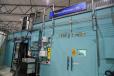
Ancillary code: SC-2
Used on:
Quokka (SANS)
The 20 position sample changer operates between -10 and 80°C. It can hold up to
20 SANS cells with different path length and volume.
The range of cells for the 20 position is described here; Selecting A Cell.
The RHS Figure shows a typical temperature ramp as a function of time 
together with the set-points. The red line represents the mean of 5 temperatures measured along the sample changer. The error bars have been estimated from the standard deviation from the mean. Some typical equilibration times for calculations of beam-time to achieve a temperature stability of ± 0.5°C:
25 °C to 5 °C ~ 60 minutes
5 °C to 25 °C ~ 50 minutes
25 °C to 50 °C ~ 75 minutes
50 °C to 25 °C ~ 80 minutes
25 °C to 80 °C ~ 85 minutes
80 °C to 25 °C ~ 90 minutes
25 °C to -10 °C ~ 85 minutes (± 1 °C)
-10 °C to 25 °C ~ 90 minutes
Some generalisations which may help you plan beam time are:
1. Smaller steps take less time to equilibrate.
2. More accurate temperature control takes longer.
3. It takes longer to heat/cool the further you are from ambient.
Ancillary code: SC-1 
Used on:
Quokka (SANS)
The 10 position heating auto changer for QUOKKA can hold up to 10 SANS cells of differing path length and volume.
The 10 position uses the demountable cell as a standard, the description is here; Selecting A Cell.
Heating range: 30-300° Celsius
* Note: 300 °C is the maximum achievable temperature. Room temperature is the absolute minimum, it is not possible to correctly control the temperature below 30 °C
Heating time: 1 hour from 30 to 300 degrees.
Uniformity: Set temperature ± 7%.
Ancilliary code: SC-3 
Used on:
Platypus (Reflectometer)
Based on a design at the ISIS neutron scattering facility in the UK up to 5 sample changes can be hermatically sealed inside the trough. The temperature range available is current 5-50C. The trough is used for studies of liquid-air interfaces

Ancilliary code: SC-4
Used on:
Wombat and Echidna (Powder Diffractometers)
An Epson E2S553 Pick and Place robot with a reach of 550mm has been purchased to allow repeated automatic sample chaning. A tray containing up to 50 Vanadium sample cans can be tested individually in the neutron beam. The robot can rotate the samples in the beam and translate up and down. If required, tested samples can be stored away from untested ones. Up to two trays (100 samples) can be loaded at once.