

Showing 1 - 20 of 55 results

User Meeting 2024 award recipients
ANSTO and the User Meeting 2024 organising committee celebrate this years award recipients.
ANSTO’s experts build new knowledge, drive innovation and support training and development for the safe management of Australia's radioactive waste
ANSTO has almost seventy years of experience in advancing an understanding of the management of spent nuclear fuel and delivering safe and reliable forms for radioactive waste.
Environmental conference highlights the role isotopes have in better supporting our precious ecosystems
Peter Lay and Wei Kong Pang recognised by ANSTO for contributions to synchrotron research
Professor Peter Lay from the University of Sydney has been awarded the Australian Synchrotron Lifetime Contribution Award by ANSTO, the Australian Nuclear Science and Technology Organisation.
ANSTO's innovative approach to treating cancer gets funding
An international team led by ANSTO has been awarded a prestigious program grant from the Foundation for Australia-Japan Studies.
PET innovation
Tool developed for producing F-18 radiopharmaceuticals for PET imaging.
Scholar Profile - Phil Sutton
Since 1962, the United Uranium Scholarship has helped promising young scientists in the field of nuclear energy extend their knowledge and expertise. In 2022, scholarships were awarded to several ANSTO researchers, including Phil Sutton.

ANSTO User Meeting - Speakers
ANSTO User Meeting 2021 - Speakers
Strategic research agreement
Strategic partnership with the University of Sydney expanded to continue a long history of research collaboration.
Capabilities
ANSTO provides access to specialised facilities and capabilities by application. Please ensure that you contact the relevant ANSTO scientist for advice before submitting a proposal.
Impact of radioactivity on the biosphere
Research to determine the potential dose from long- lived radioactive substances at mining, legacy sites and nuclear facilities.
Agreement with J-PARC opens neutron scattering conference
Innovative cancer research
An ANSTO radiochemist has been awarded a scholarship to carry out research at the world-renowned Sloan Kettering Cancer Center in New York.
A closer look at the scientific power of nuclear and accelerator techniques
In Part 2 of our series exploring the world of nuclear science and technology at ANSTO, we share more detailed information about the nuclear scientist’s toolkit.
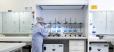
Sample preparation expertise and facilities, chemistry laboratories
The samples preparation facilities include state-of-the-art chemistry laboratories and other specialist supporting areas
ANSTO joins international counterparts in peaceful nuclear monitoring
The Australian Nuclear Science and Technology Organisation (ANSTO) has joined a team, lead by the US Department of Energy’s Pacific Northwest National Laboratory (PNNL), to install a high resolution monitoring system at ANSTO’s medical isotope production facility in Lucas Heights, Australia.
Synchrotron X-rays reveal pathway to greener fertiliser production
In a new study published in Nature Communications, researchers from UNSW have demonstrated a more sustainable alternative: an electrochemical pathway that couples carbon dioxide and nitrogen-containing species to produce urea under mild conditions.
ANSTO facilities and expertise supply a large range of radioisotopes for radiopharmaceutical and environmental applications
Excellent radiolabelling facilities and the operation of OPAL, a world-class multi-purpose nuclear reactor, enable ANSTO to produce a large range of radioisotopes for Australian researchers in both radiopharmaceutical and environmental areas.