


Showing 381 - 400 of 950 results
Accelerator Systems Overview

Capabilities
ANSTO provides access to specialised facilities and capabilities by application. Please ensure that you contact the relevant ANSTO scientist for advice before submitting a proposal.
Capabilities and applications
CAS delivers ultra-sensitive analysis and precision irradiation within an end-to-end user experience framework, supporting the research journey from initial idea through to impact and training the next generation of scientists and innovators.
Bilby study on lecithin
First paper from Bilby investigates the effects of inorganic ions on the self-assembly of lecithin

AANSS 2024 - Prizes & Awards
You are invited to submit to the various awards
Interactions of nanoplastics
Exploring the interaction of polystyrene nanoplastics and blood plasma proteins.

Space radiation testing for materials and devices
ANSTO offers capabilities and expertise for the radiation testing and accreditation of space-based systems.
ANSTO contributes to international project to evaluate economics of Small Modular Reactors
ANSTO contributes to new international project to improve how the world assesses the economic viability of Small Modular Reactors
Successful ARC Discovery Project 2024
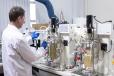
Biodeuteration
Biodeuteration involves the growth of microorganisms in a heavy water (deuterium oxide) culture medium supplemented with either a deuterated or hydrogenated carbon substrate, depending on the level of deuteration required. The biomass is harvested and the deuterated molecule (e.g. protein) is purified and characterised.
Food science: Insight into emulsions
Neutron scattering techniques help characterise the structure of a particle based emulsifier
Unusual state of matter in new material holds promise for transformative quantum technologies
ANSTO has provided supporting experimental evidence of a highly unusual quantum state, a quantum spin liquid (QSL), in a two-dimensional material.

Accommodation, Meals and Transport ANSTO-HZB Neutron Training Course 2024
Thales Project Summary
FAQs - Macromolecular Crystallography
Frequently Asked Questions on the Macromolecular Crystallography beamlines (MX1 and MX2)
50 Year Anniversary of Moon Landing
On 20 July 1969, humans landed on the moon for the very first time. As Neil Armstrong was lowered onto the surface of the moon he made the now infamous statement, “That's one small step for man, one giant leap for mankind”.
The dinosaur detectives: Instrument scientist who studies fossils and Dingo neutron imaging in the spotlight

Applications - Echidna
Applications, recent results, publications.