Search hero banner

Search results

Showing 41 - 60 of 2068 results

World Environment Day 2019. Beating air pollution

Today is World Environment Day, a United Nations initiative for encouraging worldwide awareness and action for the environment. This year’s theme is “Beat Air Pollution”, a call to action to combat this global crisis.
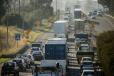

Vehicle emissions contribute to fine particle air pollution in Newcastle

Air pollution from combustion processes in Newcastle

Combustion reactions in vehicles, household woodfires and coal-fired power plants all result in fine particle air pollution in the air we breathe. ANSTO has been measuring and characterising fine particle pollution from key sites around Australia for more than 30 years. 

This data set provides records from 1998 to 2019 of the concentration of 12 elements present in fine airborne particulate matter from an air sampling station located in Mayfield in Newcastle, NSW.

BHP Newcastle Steelworks at sunrise from across the Hunter River, September 24, 1997

Monitoring fine particle air pollution in Newcastle

ANSTO has been measuring and characterising fine particle pollution from key sites around Australia for more than 30 years. 

This data set provides records from 1998 to 2019 of the concentration of 12 elements present in fine airborne particulate matter from an air sampling station located in Mayfield in Newcastle, NSW.

Minerals

How processable is your entire ore body?

You may be confident about the major crystallographic phases of your ore body – but what about those minor phases that can affect processing or cause long-term problems with remediation?

We used electrostatically-charged balloons to accumulate radon progeny from the air (Getty Images).

Investigating radiation in the air we breathe

Radon is a significant component of background radiation and can accumulate in poorly ventilated indoor environments. 

In this data set, we investigated the effect of electrostatically charging a balloon, which was then hung in an enclosed space, on its level of radioactivity. 

Students write a hypothesis, graph data, write a conclusion and use provided information to answer questions about radioactivity and radon, experimental design, accuracy, validity and reliability.

BioSAXS

Biological small angle X-ray scattering beamline (BioSAXS)

The Biological Small Angle X-ray Scattering beamline will be optimised for measuring small angle scattering of surfactants, nanoparticles, polymers, lipids, proteins and other biological macromolecules in solution. BioSAXS combines combine a state-of-the-art high-flux small angle scattering beamline with specialised in-line protein purification and preparation techniques for high-throughput protein analysis.

ANSTO's X-ray techniques support improvements in solar

Advanced X-ray techniques have revealed new structural details about the specific arrangement of atoms in conjugated polymers, an important class of materials that are used in LEDs, organic solar cells, transistors, sensors and thermoelectric power devices.

Air pollution over Sydney CBD

Monitoring air pollution and traffic density in Sydney

ANSTO Environmental Researcher Scott Chambers uses a naturally-occurring radioactive gas called Radon-222 to trace sources of pollution in the atmosphere. 

This data set contains hourly observations of meteorology, trace gas pollutants, Radon-222 concentration and traffic density collected from Western Sydney University (Richmond campus) in 2016.

New beamline provides state-of-the-art imaging capability

The new Micro Computed Tomography (MCT) beamline is the first instrument to become operational as part of the $94 million Project BRIGHT program, which will see the completion of eight new beamlines at ANSTO’s Australian Synchrotron.

Pagination