What is radiation?
![]() |
| Sunrays over a field of pasture |
Short cut links:
- Introduction to radiation
- Radiation doses
- Units of ionising radiation dose
- Cancer risk
- Cosmic radiation dose rates at different altitudes
- Questions and answers
- Your average annual radiation dose
- Medical uses
- Medical radiation sources
Introduction to radiation
Radiation can be described as energy or particles from a source that travel through space or other mediums. Light, heat, microwaves and wireless communications are all forms of radiation. The kind of radiation discussed here is called ionising radiation because it can produce charged particles (ions) in matter.
Ionising radiation is emitted by a large range of natural materials, can be produced by everyday devices such as X-ray machines, and can also be emitted by unstable atoms. Atoms become unstable when they have the wrong amount of mass required to keep them stable, an excess of energy, or both. Unstable atoms are said to be radioactive.
In order to reach stability these atoms give off, or emit, energy and/or mass. The energy is emitted in the form of electromagnetic radiation (i.e. light) and the mass is in the form of tiny particles. These emissions are called nuclear radiation and such atoms are said to be radioactive.
Gamma radiation is an example of electromagnetic radiation. Beta and alpha radiation are examples of emitted particles. Ionising radiation can also be produced by devices such as X-ray machines.
Radiation doses
Ionising radiation and radioactive materials are widely used in medicine, industry, agriculture, environmental studies, pollution control and research. These uses benefit each of us individually and the Australian community as a whole.
Units of ionising radiation dose
Cancer risk
Cosmic radiation dose rates at different altitudes
![]() |
Question and answer
A. No, just as light will not make you glow in the dark and a chest X-ray will not make you radioactive.
A. In a reactor there are billions of free nuclear particles called neutrons. When absorbed by a material they may make it radioactive, i.e. it emits its own radiation. This is how radioisotopes are made.
A. Ionising radiation does not build up in your body any more than light which falls on you builds up. The radiation that reaches you is gone a fraction of a
second later. Radiation effects may appear following exposure to high doses in a short time, just as a bad dose of sunburn results from too much exposure to sunlight too quickly. Similarly, long term exposure to ionising radiation at high levels may cause permanent damage to the body.
National and international dose limits for occupationally exposed workers and members of the public are many times lower than these high levels. In addition, the goal of radiation protection is to keep long term environmental exposure, above normal background radiation, to a minimum.
A. Radiation carries energy which may damage living cells in the same way as tobacco smoke, asbestos or ultraviolet light. If the dose is low or is delivered over a long time there is an opportunity for the body cells to repair. There is only a very small chance that some cells may have been damaged in such a way that effects such as cancer appear in later life.
A. Mainly from the decay of natural radioactivity in the earth, mostly from uranium and thorium. This gives rise to a radioactive gas called radon in the air we breathe. Radon is in all buildings. Smaller and roughly equal parts of everyday radiation come from cosmic rays and from the natural radioactivity of our food and drink. Some radiation is man-made.
A. Medical uses of ionising radiation are the major items. These include the use of X-rays and radioactivity in nuclear medicine.
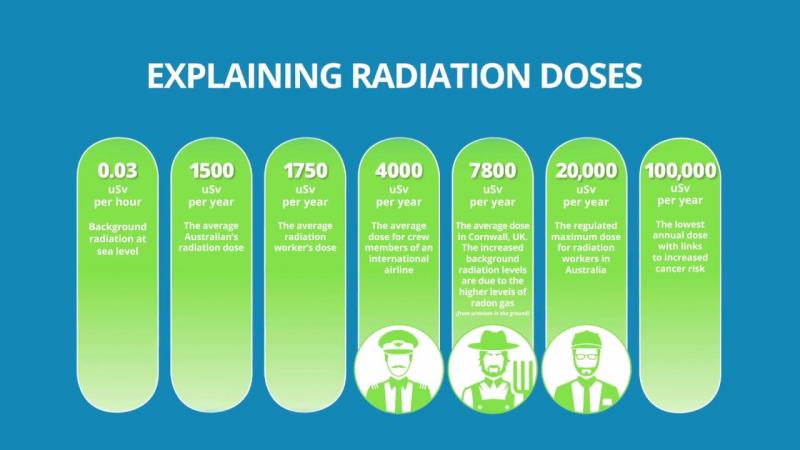
A. On average, Australians receive 1500 μSv a year from natural background radiation. Your additional dose from the medical use of radiation would depend on your medical history. The dose from a chest X-ray would be very small, about 1.5 per cent of the annual dose due to natural background radiation, while multiple X-rays, in conjunction with barium enema, may be several times larger than the annual background dose. Radiation doses in cancer therapy
may be larger still.
A. Yes. Cosmic rays vary with altitude, with height above sea level and with sun spot activity. Some rocks, like granite, and beach sands are more radioactive than other parts of the earth. Some foods, like olives and brazil nuts, accumulate more radioactivity than others. But the most important variation is in varying radon levels, brought about by differences in building materials, ventilation and water supplies.
A. When whole populations exposed to high background doses are compared to those exposed to low background doses, health differences are not detected. The human race has evolved over millions of years in this radioactive environment.
A. The dose that a member of the community living near ANSTO would receive from our operations is very small. Those people living close to the buffer zone (which extends to 1.6km from the reactor) would receive less than 10 μSv per year. This is only 0.7 percent of the average natural background radiation in Australia. People living further away would receive proportionately less. This 10 μSv maximum dose is about the same as the dose received from cosmic rays during a return flight between Sydney and Melbourne.
The average annual radiation dose per person per year is approximately 1500 μSv
| 50μSv | Travel and power stations- |
| 300μSv | Cosmic rays- |
| 400μSv | Food and drink-
|
| 800μSv | Terrestrial radiation- The major part of your average terrestrial radiation dose (200 μSv a year) therefore derives from the decay of radon and thoron in your lungs. In the open, these gases are diluted by the wind mixing them in the atmosphere. Indoors they may concentrate in still air. |
| Deduct 10% | If you live in a wooden house |
| Deduct 20% | If you live in a tent |
| Deduct 50% | Or more if you live in the open |
| Add 10% | Or more if you live in a granite building |
| Add 100% | Or more if you keep doors and windows shut |
| Add 100% | Or more if you use bore water, especially in a hot shower. Because bore water has been underground, it contains radon that is released when the water emerges from the bore. The release is enhanced when the water is heated or divided into droplets; it is therefore most marked in a hot shower. |
Typical doses received during various diagnostic X-ray examinations
| X-rays (conventional) | |
| Chest | 20 μSv |
| Leg or foot | 20 μSv |
| Dental | 5-10 μSv |
| Skull | 70 μSv |
| Barium metal | 2500 μSv |
| Intestine | 3000 μSv |
| Mammography | 400 μSv |
| X-rays (computerised tomography) | |
| Routine head | 2600 μSv |
| Routine abdomen | 13000 μSv |
Examples of alpha, beta and gamma emitters
Medical uses
Medical radiation sources
| Scans | Dose |
| Bone Scan | 4600μSv |
| Thyroid Scan | 2600μSv |
| Lung Scan | 2600μSv |
| Liver Scan | 1700μSv |
| Kidney Scan | 1400μSv |
| Soft tumours | 40000μSv |
| X-rays | See above |
Other Nuclear Information
![]() | ![]() | ![]() | ![]() |
| About Nuclear Science | Benefits of nuclear science | Managing Radioactive Waste | Glossary of Nuclear Terms |