How OPAL works

Reactor pool illustration

Reactor pool

OPAL, as a nuclear research-reactor, is a facility in which a nuclear fission chain reaction can be maintained and controlled.

The key event in the reactor is fission, in which a neutron hits the nucleus of an uranium atom and splits that atom.

Energy is released, some of which is carried away by neutrons released from the atom. These neutrons are what the scientists and engineers use for bombarding materials, or for the development of new radioisotopic products.

Two or three neutrons are produced when a uranium-235 atom fissions, and are released at high energy. In order for fission to support a chain reaction, the neutrons need to be moderated and reflected back into the fuel.

In OPAL, those tasks - moderation and reflection - are performed by the cooling water flowing through fuel assemblies in the core and heavy water (D20) contained in the reflector vessel surrounding the core.

Looking into OPAL

Looking down into OPAL

Reaction

When operating at its maximum 20 megawatts, a strong blue glow, called Cherenkov radiation, is visible surrounding the core in the pool.

Core

The compact core of the reactor is a notable feature. The whole core size is only 35 cm square and just over 60 cm high, about the size of a two-drawer filing cabinet. The small size maximises the flux of neutrons available for radioisotope production irradiation of materials, and research.

The core is an arrangement of 16 fuel assemblies, in a four by four square matrix. Each of these assemblies is 8 cm square and holds 21 aluminium-laminated plates of low-enriched uranium.

The fuel core and control rods are located approximately 10 metres below the surface of the pool.

Fuel

OPAL uses low-enriched uranium fuel with around 20 per cent uranium-235. The remainder is U-238. The fuel is sandwiched between aluminium alloy plates which are then joined into side plates to form the fuel assemblies.

Control rods

There are five carefully positioned neutron absorbing control rods (or plates) of Hafnium within the core between the fuel assemblies; they control the rate at which fissions occur and hence the reactivity of the reactor. The control rods are raised and lowered out of and into the core via a drive mechanism located below the core. One of these control rods is cruciform in shape and centrally located within the core. The rods also enable the reactor to be shutdown or tripped if required.

Reactor pool

The open pool design allows operators to see directly into the reactor core and the irradiation facilities in the surrounding reflector vessel to perform various tasks such as refueling the core and unloading/loading the irradiation facilities.

The 13 metre deep reactor pool contains approximately 200 cubic metres of demineralised ordinary water (H2O), which acts as a coolant and a radiation shield.

For more information, download our poster.

Reflector vessel

The reflector vessel is a cylindrical tank of heavy water (D2O) sitting at the base of the pool of lighter water containing the core. It is used as a neutron reflector and as a location for the irradiation facilities. It is made of zirconium alloy, 2.6 m in diameter and 1.2 m high. This vessel is vital in operating the reactor, as the heavy water reflects high energy neutrons released back into the core, maintaining the nuclear reaction.

The majority of neutrons enter this vessel at high energies. As they pass through the heavy water they lose this energy and are eventually reflected back into the core. Meanwhile, some neutrons escape and are absorbed by irradiation targets located in the reflector vessel, so not all the neutrons find their way back to the core. Some neutrons also find their way into neutron guides where they are channelled through mirrored guides to various research instruments.

While its main purpose is to sustain the nuclear reaction, draining the vessel provides an efficient second means of shutting down the reactor.

Service pool

The reactor pool is linked through a transfer canal to a service pool with a moveable gate for isolating the pools from each other. The service pool is used for loading and storage of irradiated silicon, radioisotopes and the storage of spent fuel. There is a capacity to store up to ten years of spent fuel.

Cooling

When operating, water circulates through coolant channels between the fuel plates to remove heat produced by the fission reaction.

The primary OPAL cooling system operates at approximately 37°C. Two main pumps circulate water through the core and heat exchangers. Another set of pumps then circulate cooling-tower water through these heat exchangers transferring the 20 MW to the cooling towers. Core cooling is maintained either by the main pumps during power operation or via natural circulation when the reactor is shutdown. Natural circulation occurs when pool water passes through the core in convection currents; that is warmer water rises and is replaced by cooler water. People will always see steam clouds near a reactor when it's operating, as a result of the cooling process.

Shutdown

The control plates can either be lowered or dropped under gravity depending on the speed of reactor shutdown required. The quickest shutdown possible from full power takes less than a second. The Hafnium rods absorb neutrons thereby reducing the fission rate and effectively stopping the nuclear chain reaction.

The second shutdown system is also available as an independent and diverse means to shutdown the reactor. This system drains half of the heavy water from the reflector vessel preventing neutrons from being reflected back into the core and effectively stopping the nuclear chain reaction from occurring.

Building

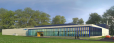
The reactor is housed in a steel reinforced building designed to withstand external events, including a one in ten thousand year seismic event, or impact from a light aircraft.

In addition to providing structural integrity, the mass of re-enforced concrete forms a structural base for the reactor.