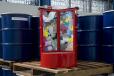
Managing Radioactive Waste
ANSTO has safely managed its radioactive waste for over 60 years. Waste is managed in accordance with national and international standards.


Showing 1 - 20 of 20 results
ANSTO has safely managed its radioactive waste for over 60 years. Waste is managed in accordance with national and international standards.

An accomplished international photographer has capture dazzling new images of one component of the main ring at our Australian Synchrotron and provided an inside view of the electron’s path when it is used.
In January 2026, Mr Michael Quigley AM, ANSTO Board Chair, shared ANSTO's Statement of Intent with the Minister for Industry and Innovation, and Minister for Science.

Explore ANSTO's range of publications and reports available for the public.
Scientists at ANSTO characterise structures with atomic detail using probes such as x-rays, electrons, neutrons and ions.

ANSTO is an experienced provider of Teacher Professional Development for Australian and International teachers and our courses cover a wide range of topics. Hear from expert speakers, receive new education resources, and develop lessons for your own class.
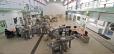
Nuclear Reaction Analysis (NRA) detects charged particles and is used predominantly to determine concentrations and depth profiles of the lighter elements.
Australia’s Nuclear Science and Technology Organisation (ANSTO) is well-known for facilitating incredible science and creating life-saving nuclear medicines, but for the last 40 years it’s been quietly producing a largely unsung net zero hero: Neutron Transmutation Doped (NTD) silicon.
ANSTO researchers have demonstrated longstanding expertise in the study of nuclear fuel and radioactive waste with two recent journal articles in a special issue of Frontiers of Chemistry.
A Powerhouse exhibition was recognised with a prestigious Museums and Galleries National Award for Research at a ceremony in Perth this morning. The Invisible Revealed exhibition was organised in collaboration with ANSTO and the University of NSW.
Seeing inside an ancient Australian Indigenous artefact non-invasively using neutron tomography.

Your students can analyse real research data from ANSTO scientists.
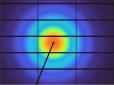
The Biological Small Angle X-ray Scattering beamline will be optimised for measuring small angle scattering of surfactants, nanoparticles, polymers, lipids, proteins and other biological macromolecules in solution. BioSAXS combines combine a state-of-the-art high-flux small angle scattering beamline with specialised in-line protein purification and preparation techniques for high-throughput protein analysis.
Australian and Taiwanese scientists have discovered a new molecule which puts the science community one step closer to solving one of the barriers to development of cleaner, greener hydrogen fuel-cells as a viable power source for cars.

Highlights of the Magnetism Project.