

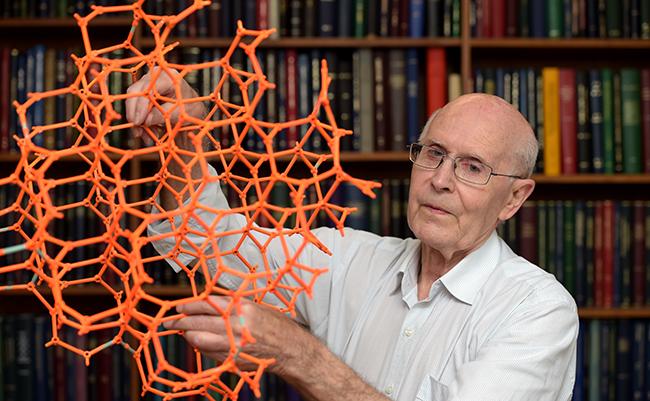
ANSTO congratulates Australian scientist Prof Richard Robson (University of Melbourne) on the award of the Nobel Prize for Chemistry which he shares with Prof Susumu Kitagawa (Kyoto University), and Prof Omar M. Yaghi (University of California, Berkley). The Prize was awarded in Stockholm on 10 December.
Prof Robson established the fundamental principles underpinning chemical compounds, which he named coordination polymers in the late 1980s and early 1990s. He has continued to explore this area of chemistry through to the current day.
Pro Yaghi and Professor Kitagawa each subsequently explored major aspects of the general field of Coordination Polymers, which came to be known as Metal Organic Framework (MOFs), as identified in the award.
Prof Robson’s long-time collaborator and co-author of the seminal papers for which the Prize was awarded, the late Dr Bernard Hoskins, was a staff member at ANSTO for several years prior to commencing his PhD studies in the late 1950s. Whilst an academic staff member at University of Melbourne, he made use of the single-crystal neutron diffractometer at HIFAR (now de-commissioned).
“Bernard's mastery of crystallography is a legacy from which many crystallographers worldwide, including some ANSTO staff have benefited,” said Dr Alison Edwards a Senior Principal Research Scientist and Instrument Scientist at ANSTO who undertook her PhD studies with Dr Bernard Hoskins at the University of Melbourne.
Her thesis reports determining structures conceived by Prof Robson and created metal complexes of tetranucleating ligands – among the forerunner compounds identified by Prof Robson in his prize award lecture as exploiting his life-long design principles and inspiring the awarded work.
ANSTO facilities have played a part in recent key developments in Coordination Polymer science, including MOFs, with many groups including Professor Robson's own and those of his immediate collaborators and others employing the MX beamlines at the Australian Synchrotron to identify novel structures for more detailed examination using high precision laboratory diffractometers.
Early neutron diffraction studies of the compounds employed the original Koala single-crystal diffractometer and challenging experiments in gas loading and other in situ and in operando studies have featured on the WOMBAT powder neutron diffractometer.
MOFs: An explainer

Metal-Organic Frameworks (otherwise known as ‘MOF’s or Porous Coordination Polymers), as originally named by Prof Robson are a class of materials that are built from a combination of metal and organic molecular building blocks to have large void spaces – or pores.
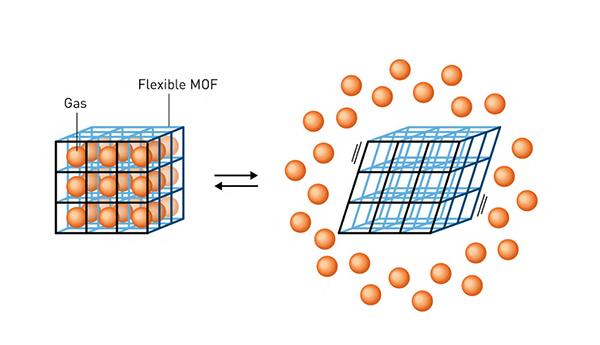
From the outset, scientists realised that these void spaces can be used in many ways; from the storage of gases, to capturing water from the driest of conditions, through to providing the tiniest of chambers for chemical reactions.
The innovation that chemists could design these structures from the atom up, and tailor them to the problem that they are trying to solve, galvanised many into action – there are now hundreds of thousands of MOFs that have been designed and made.
Thanks to Dr Alison Edwards, Dr Helen Maynard Casely and Dr Rosemary Young for their contributions to this article.

