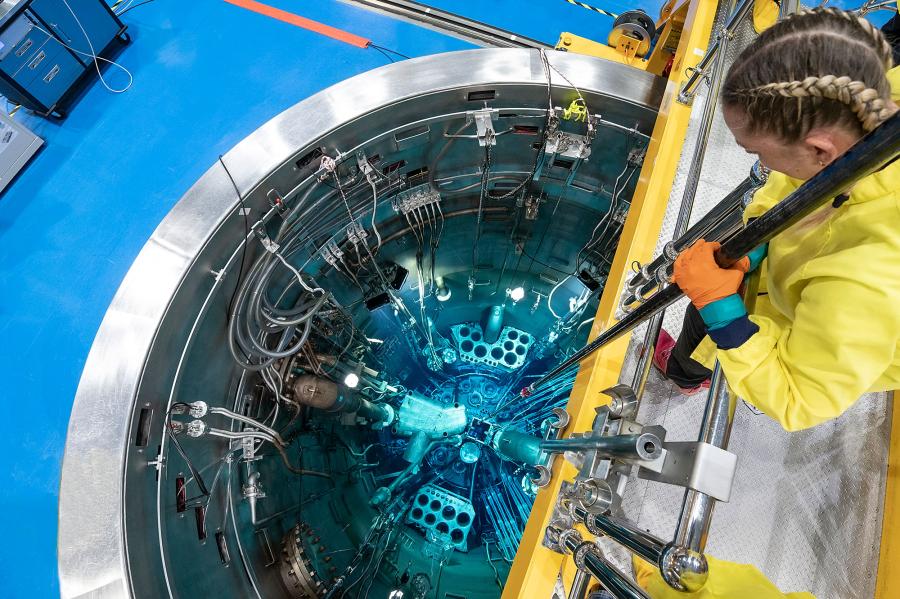
ANSTO operates Australia’s only multi-purpose nuclear reactor. Located in Southern Sydney at Lucas Heights, it supports healthcare, scientific research, advanced manufacturing and Australia’s nuclear expertise.

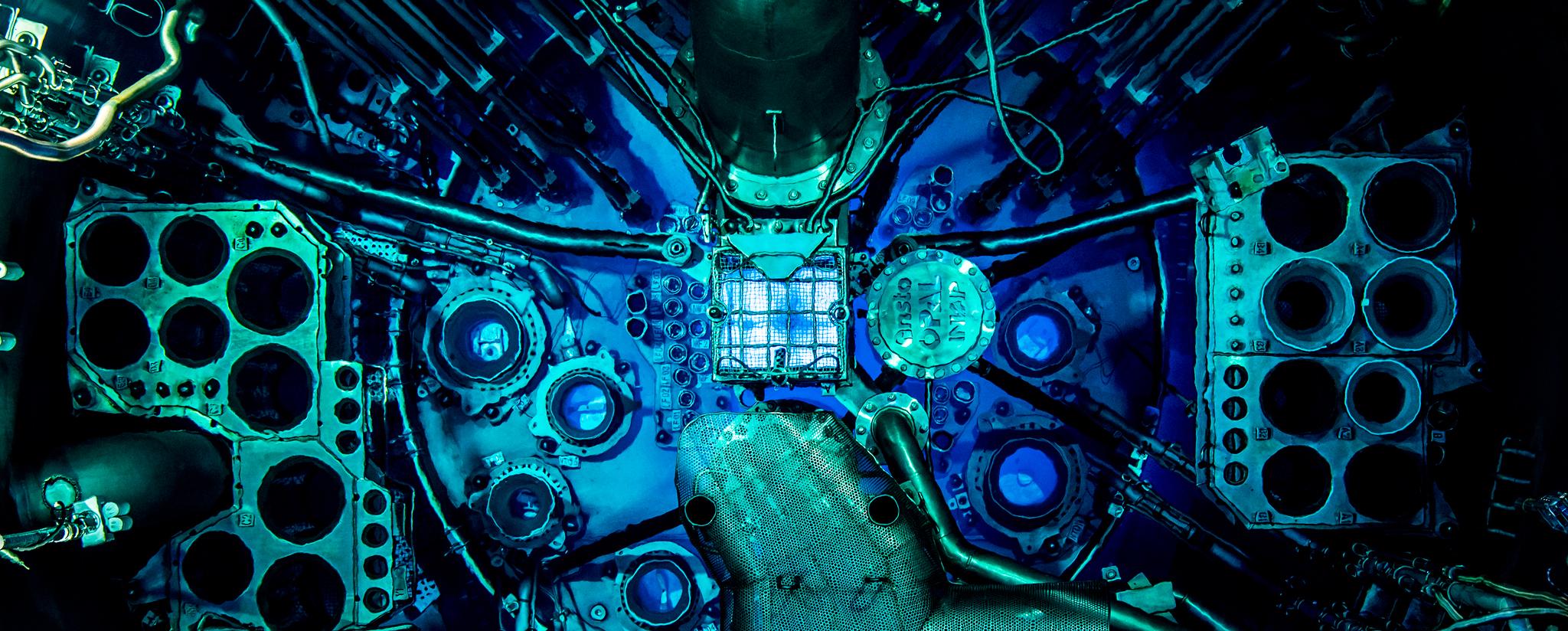
ANSTO operates Australia’s only multi-purpose nuclear reactor. Located in Southern Sydney at Lucas Heights, it supports healthcare, scientific research, advanced manufacturing and Australia’s nuclear expertise.
OPAL stands for Open Pool Australian Lightwater reactor.
Australia’s OPAL reactor is one of a number of similar facilities around the world.
OPAL plays a vital role in society by functioning as a 'neutron factory', producing radioisotopes used to diagnose and treat disease, irradiating silicon for use in advanced electronics and green technologies, and generating neutrons for fundamental materials research.
OPAL is a state-of-the-art 20-megawatt multi-purpose reactor that uses low enriched uranium-235 fuel.
The reactor works by carefully controlling a process called nuclear fission inside fuel assemblies containing uranium. During fission, uranium atoms split and release neutrons and heat. These neutrons are then used for neutron beam research and the irradiation of materials.
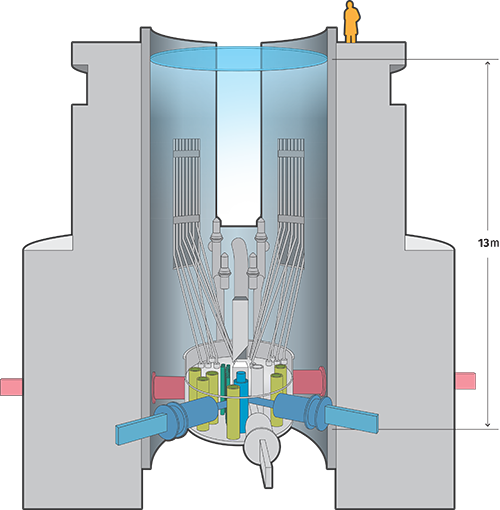
At the heart of the reactor is a compact core of 16 fuel assemblies arranged in a 4 × 4 array, with five control rods used to regulate reactor power and facilitate shutdown.
The fuel assemblies are cooled by purified water and are surrounded by a zirconium alloy reflector vessel containing a special type of water known as heavy water. The heavy water helps improve reactor efficiency by reflecting some neutrons back towards the core, where they can continue to support the nuclear reaction.
The reflector vessel is positioned at the bottom of a 13-metre-deep pool of light water. This purified water acts as a coolant and radiation shield, while the open-pool design allows operators to safely observe and manipulate items within the reactor pool.
The neutrons generated by OPAL are used in several ways, delivering benefits across medicine, research and industry.
Some of the neutrons produced inside the reactor are directed into specialised facilities where they can be used to produce radioisotopes for nuclear medicine. Others travel along beamlines to scientific instruments, allowing researchers to study the structure of materials, molecules and other substances in extraordinary detail.
The reactor can also be used to irradiate silicon, altering its conductive properties so it can be used in advanced semiconductor devices.
This capacity, combined with the open pool design, the use of low enriched uranium fuel and the wide range of applications, places OPAL amongst the best multi-purpose reactors in the world.

For 20 years, OPAL has been at the heart of nuclear science in Australia. As Australia’s only operating nuclear reactor and one of the world’s most utilised multi-purpose reactors, OPAL has delivered world-class science, supported critical industries and helped improve lives every day.
Learn moreOPAL supports a diverse community of internal and external users, including ANSTO scientists and engineers, researchers from Australian and international universities, medical and healthcare organisations, government and science agencies, and industrial partners.
While OPAL is extremely versatile and the applications of neutron science are broad, its primary uses are:
Irradiation of target materials to produce radioisotopes for medical and industrial applications
Research in materials science using neutron beams and associated instruments
Analysis of minerals and samples using neutron activation analysis and delayed neutron activation analysis techniques and
Irradiation of silicon ingots (known as Neutron Transmutation Doping or NTD) for use in the manufacture of electronic semiconductor devices
For more information on user access to ANSTO facilities, visit our User Access pages.
OPAL runs for 24 hours a day. It is scheduled to operate for 300 days each calendar year. OPAL typically operates in cycles of 30 – 35 days, followed by a short re-fuelling outage to remove the spent fuel assemblies and replace them with new fuel assemblies.
Routine maintenance and inspections are also carried out during these planned shutdowns.
ANSTO continuously monitors performance, maintenance requirements and long-term asset management to ensure the reactor remains available to support its diverse users.
OPAL was designed for long-term operation and ANSTO continues to invest in programs that support its future use.
Learn more about OPAL's operating cycles.
OPAL is designed and operated to the highest safety standards, using proliferation-resistant, low enriched uranium fuel, and passive safety features, in accordance with international best practice.
Key features include:
low enriched uranium fuel
multiple engineered safety systems
passive safety features
robust operating procedures
highly trained specialist staff and
independent regulatory oversight.
Access to the reactor is tightly controlled and security arrangements include dedicated security personnel and support from the Australian Federal Police.
OPAL is independently regulated by the Australian Radiation Protection and Nuclear Safety Agency (ARPANSA) and the Australian Safeguards and Non-Proliferation Office (ASNO), and operates in accordance with internationally recognised standards and guidance developed by the International Atomic Energy Agency (IAEA).
Learn more about OPAL's safe design and features.
OPAL uses nuclear fission in which the nucleus of an atom of uranium-235 (in the fuel) splits into smaller atoms generating new neutrons. These extra neutrons hit surrounding uranium-235 atoms, which in turn split and generate more neutrons. This multiplying effect creates a chain reaction in a fraction of a second.
Light water is purified water (H₂O), the same type of water found in rivers, lakes and household taps. Heavy water is water in which the hydrogen atoms are replaced with a naturally occurring heavier form of hydrogen called deuterium (D₂O).
Although OPAL contains both light water and heavy water, it is classified as a light water reactor because ordinary water is used as the primary coolant and moderator within the reactor system. The heavy water serves a specialised role within the reflector vessel surrounding the core.
One of OPAL's most distinctive features is its open pool design. When viewing the reactor pool, a brilliant blue glow, known as Cherenkov radiation, can sometimes be seen.
OPAL was specifically designed to operate using a low enriched uranium (LEU) fuel. OPAL’s use of LEU significantly reduces proliferation risks, especially compared to reactors that use highly enriched uranium.
Proliferation-resistant means the fuel is highly resistant to potential use in nuclear weapons (proliferation). LEU fuel is proliferation-resistant.
OPAL cannot produce electricity. It wasn’t designed to be capable of producing electricity. It can’t be modified to produce electricity.
Known as thermal capacity, OPAL is a 20-megawatt multi-purpose reactor.
By comparison nuclear power reactors in France, Finland, the Republic of Korea and the US exceed 1400-megawatts, that’s 70 times the wattage of OPAL.
OPAL is small but scientifically mighty.
OPAL is protected by ANSTO’s Security Operations Centre and the Australian Federal Police. Both are on campus 24/7. Access to OPAL is highly regulated and restricted.
OPAL is run 24 hours a day seven days a week, excluding shutdown periods for activities like maintenance. We aim to operate 300 days per calendar year, typically in cycles of 30–35 days.
In the 2025-2026 financial year, OPAL operated 98.3 per cent of the time it was scheduled to operate.
OPAL was designed to have an operational life of at least 40 years but ANSTO is working to extend OPAL’s use well beyond that. OPAL’s exceptional service life and operating record is a credit to both its design and its maintenance.
At the base of the OPAL reactor is a cylindrical vessel, known as the reflector vessel. Tubes that penetrate the reflector vessel allow beams of neutrons, which are atomic particles, to be guided to a suite of sophisticated scientific instruments at the Australian Centre for Neutron Scattering. Researchers use these powerful non-destructive scientific instruments to reveal information about the structure and motion of materials at the atomic scale.
The facility delivers research outcomes for a vast array of scientific disciplines and industry applications: medicine, food, engineering and construction, mining, advanced technologies, palaeontology, cultural heritage items, planetary and space studies, and much more.
OPAL is the foundation of Australia’s capability in nuclear science and technology. As the nation’s only operating nuclear reactor, it helps to maintain Australia’s nuclear literacy, capability and credibility in a changing strategic environment. It sustains the expertise, infrastructure, safety culture and international confidence needed to be recognised as a responsible and capable nuclear nation.
Nuclear medicines are used in the diagnosis, staging and treatment of disease and various medical conditions.
NTD stands for Neutron Transmutation Doping. NTD silicon is sometimes called irradiated silicon.
NTD silicon is a highly specialised material used in power semiconductors, the ‘control centres’ of modern energy systems. ANSTO is the world’s largest producers of irradiated or NTD silicon, a critical material driving the global electrification movement and enabling greener technologies.


