Our research
Small molecular OSCs, as an alternative to polymer based systems, are more favoured in industrial applications, due to the high degree of structural elucidation possible, synthetic reproducibility and ability to form crystalline thin films. Critical for OSC performance is the crystallinity, size and orientation of n-type and p-type semiconductor domains within the films.
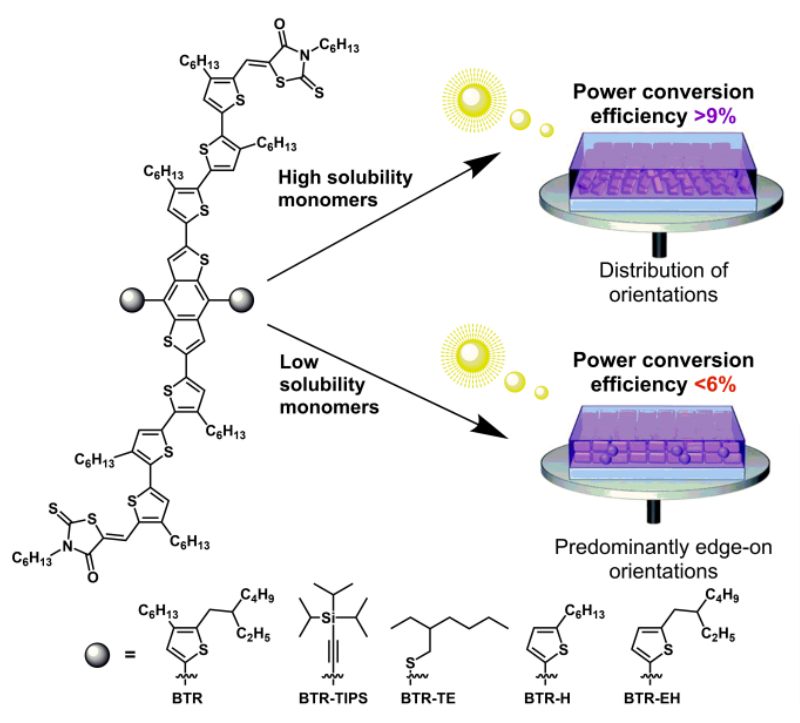
In this publication, monomers were synthesised with an electron-rich benzodithiophene (BDT) core unit, flanked by alkyl-substituted terthiophene π-bridges and end�capped with electron-poor rhodanine units, and a series of BDT headgroups, in order to investigate the impact of differing steric bulk and solubility of the headgroups. Thin films were formed by spin coating of the monomers, followed by solvent vapour annealing.
In order to elucidate the impact of the different headgroups on the crystalline structure and orientation of their corresponding thin films, grazing-incidence wide-angle X-ray scattering (GIWAXS) and macromolecular crystallography (MX) were used to qualitatively and quantitatively analyse the structures on a nanometer scale. GIWAXS was used because it reveals the orientation of the monomers in the film relative to the substrate.
It was observed that films with the highest power conversion efficiency (>9%) were made with the monomers with the highest solubility, and formed films with a distribution of orientations. The films with lower power conversion efficiency, made with the less soluble monomers, formed films with predominantly edge-on orientations, which in unfavourable for photovoltaic performance.