

ANSTO has secured a $1.62 million Medical Research Future Fund (MRFF) grant under the Australian Brain Cancer Mission’s 2024 Brain Cancer Discovery and Translation program, administered by the Department of Health and Aged Care.
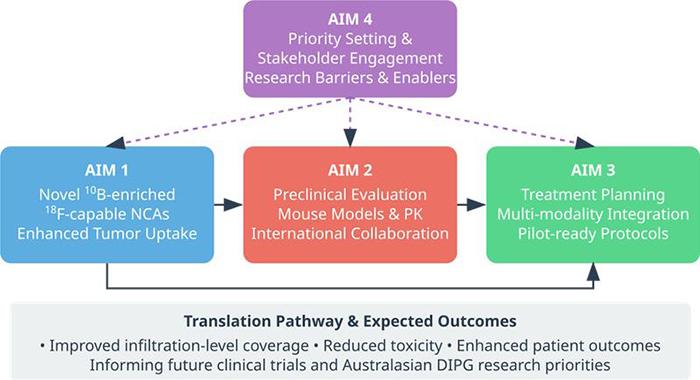
The four-year project, Targeting Glioma with Precision Radiotherapy and Biochemical Dose Amplification, will further develop Neutron Capture Enhanced Particle Therapy (NCEPT) for aggressive brain tumours such as glioblastoma and diffuse intrinsic pontine glioma (DIPG).
The research brings together physicists, chemists, radiobiologists, clinicians, health economists and consumer advocates from ANSTO, Australian universities and international particle therapy centres to move NCEPT towards clinical trials.
The project aims to provide a new treatment option for brain cancers that currently have very few effective therapies and to reduce treatment time, side effects and the need for Australians to travel overseas for cutting-edge particle therapy.
Research activities
-
Design and synthesise new tumour-targeting neutron capture agents (and their imaging diagnostic analogues) that can cross the blood–brain barrier and selectively accumulate in glioma and diffuse midline glioma cells.
-
Test these agents in cell and pre-clinical models of glioblastoma and DIPG, measuring how much additional dose can be delivered to tumour tissue and how effectively tumour growth can be controlled.
-
Develop next-generation treatment planning software platform that combine particle beam dose and neutron capture dose using GPU-accelerated Monte Carlo simulations and machine-learning–based planning.
-
Compare NCEPT plans with current best-practice proton and carbon-ion therapy, assessing potential gains in tumour control probability and reductions in normal-tissue complication probability for real Australian patient datasets.
-
Codesign clinical trial–ready protocols with Australian and international clinicians, as well as consumer and carer groups, focusing on treatment schedules that minimise time in hospital, sedation and travel burden for families.
Building towards clinical trials in new particle therapy centres
Australia is in the process of commissioning its first clinical proton and ion-beam therapy centres, including the Australian Bragg Centre for Proton Therapy and Research in Adelaide and an additional facility planned in Brisbane. A multi-ion therapy facility has been proposed for establishment in Sydney.
By the time these centres are fully operational, the MRFF-funded project aims to have validated NCEPT drug candidates, integrated particle and neutron capture treatment planning tools, and clinician and consumer-approved pilot protocols ready for early-phase clinical trials.
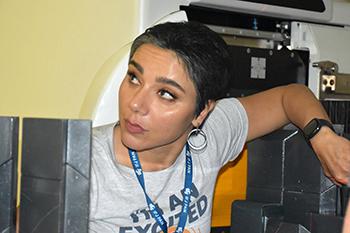
“Particle therapy is a once-in-a-generation investment for Australian cancer care,” said Dr Safavi-Naeini (pictured left). “If we can layer NCEPT on top of that capability, we give those centres a way to go even further, especially for cancers that currently have almost no effective options.”
Collaboration across Australia and around the world
The project is anchored at ANSTO but deliberately structured as a multi-institutional collaboration. Partners include:
-
Australian universities and health services: University of Technology Sydney, Queensland University of Technology, University of Newcastle, University of Wollongong, University of South Australia / Centre for Cancer Biology, South Australian Health and Medical Research Institute and the Australian Bragg Centre for Proton Therapy and Research, and Central Adelaide Local Health Network.
-
International particle therapy and modelling centres: National Institutes for Quantum Science and Technology (Japan), Institute of Nuclear Physics Polish Academy of Sciences (Poland), and Sapienza University of Rome (Italy).
-
Consumer and advocacy partners: DIPG Research Forum, Brain Tumour Alliance Australia, SAHMRI Consumer Advisory Group and the Cancer Quality of Life Expert Service Team (CQUEST), together with individual carers and brain cancer survivors.
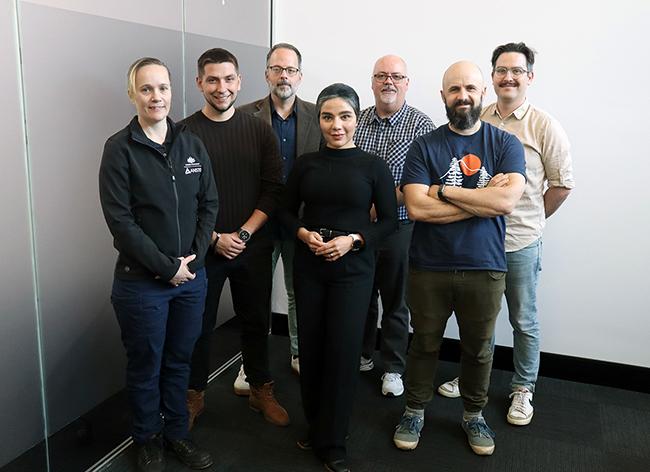
Within ANSTO, the funding is governed through three broad streams under the overall leadership of Dr Mitra Safavi-Naeini as Chief Investigator A; a preclinical radiobiology stream led by Nicholas Howell and Dr Frederic Sierro; a medicinal chemistry and radiopharmaceutical stream led by Dr Chris Dobie and Dr Giancarlo Pascali; and a treatment‑planning and health-outcomes stream led by Dr Klaudiusz Jakubowski and Dr Safavi-Naeini.
For ANSTO, the grant underscores the importance of national nuclear science and accelerator infrastructure to health and medical research. NCEPT builds directly on ANSTO’s longstanding expertise in reactor and accelerator technology, neutron scattering, radiochemistry and radiobiology.
By developing techniques that shorten treatment courses, improve tumour control and reduce off-target toxicity, NCEPT provides a new treatment option for brain cancers that currently have very few effective therapies, and has the potential to lower downstream costs to the health system and reduce the need for Australians to travel overseas for care, particularly under the Medical Treatment Overseas Program.