

The Challenge
The efficient separation of radionuclides of interest and chemically similar elements, such as the lanthanides or actinides, is critical for nuclear medicine, waste management and advanced materials. However, identifying suitable materials or separation systems is typically slow, labour-intensive, resource-heavy and requires extensive chromatographic testing. These challenges create bottlenecks in developing new radiochemical processes and limit the capacity to rapidly optimise separations for emerging isotopes and applications.
The Solution
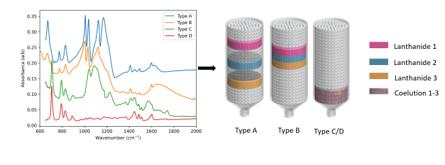
The study developed a rapid, analytical screening approach to evaluate materials and predict their performance in radionuclide separations without full testing. By combining spectroscopic characterisation with physical parameters, such as resin structure and composition, the method enables the classification of materials based on functional groups and binding behaviour. This solution allows researchers to correlate chemical structure with separation performance and identify the materials most suitable for resolving closely related elements. The methodology significantly reduces experimental burden by replacing time-consuming separation trials with faster predictive analysis. The study demonstrated that specific structural features, such as functional groups and polymer composition, strongly influence separation efficiency. It provides a practical framework for selecting and optimising materials in radiochemical and analytical workflow.
The Impact
This work enables faster, lower-cost development of radiochemical separations to accelerate research and the production of medically important isotopes. By improving efficiency and reducing waste, it supports scalable and sustainable isotope processing. The findings also advance the scientific understanding of structure-function relationships in separation materials with benefits for nuclear medicine, environmental monitoring and nuclear applications.