
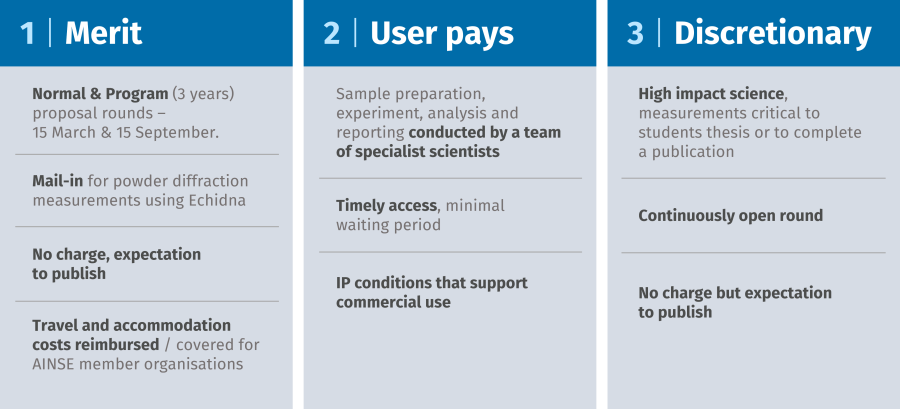

At the Australian Centre for Neutron Scattering, we have a range of instruments that use neutron beams to investigate materials across a wide variety of length scales. These instruments are made available to the Australian and international community through our user program, where we have three access routes suitable for research or industry.
Our Merit access program is available to researchers through an open call for proposals administered through our User Portal. Though this access there is an expectation to publish your results. We typically call for proposals twice a year, with deadlines around the 15th March and 15th September. Each proposal will be subject to scientific, technical and safety reviews before being ranked by our proposal assessment committee. Additionally, we run a mail-in program for powder diffraction measurements on our Echidna instrument – please see the Echidna mail-in page for more details on how to access this.
Our User pays model is designed for access where publication is not expected and beam time may be required with minimal waiting time. This is generally more suited for commercial and industry access, please see our Industry pages for more information on this.
Discretionary time can be applied for anytime and is intended for timely high-impact science. These proposals are granted at the discretion of the ACNS director and will be subject to technical and safety reviews.


Experimental support
Once granted time on our instruments, through any of our modes of access our users can expect support from the team of scientists running each instrument. Your experiment local contact will co-ordinate scheduling and access to complementary instruments, laboratory support and sample environment.
Terms and Conditions of instrument time
Conducting the experiment
Before coming on site external researchers using ACNS Neutron Beam Instruments will have informed their employer about their working in a nuclear installation and that they may be exposed to ionising radiation. On arrival, they must complete the obligatory safety training and respect all applicable ANSTO regulations.
Each user will be required to sign an agreement accordingly. The proposers will have obtained authorisation by their respective employer to carry out experiments at ANSTO.
Experimental samples and conditions must be as quoted in the proposal. The proposal should provide details on all the samples that the researchers intend to put in the neutron beam (after approval the sample section of the proposal can be updated).
Essentially, each and every sample needs to have a Safety Data Sheet (SDS). Removal of samples after the experiment will depend on possible irradiation during the experiment and the indications on sample treatment given in the proposal.
Researchers using the facility must ensure that they are insured against the risk of illness, surgical expenses and industrial accidents. Researchers with pace-makers must consult ANSTO's medical service before going into the neutron-guide or reactor hall.
Publication co-authorship
Most merit access research using our facilities will likely be collaborative, and we expect co-authorship for one or more of our staff on any resulting publications.
Some merit access research may be "service" work, in the sense that there will be minimal support from ACNS staff (ie instrument set-up and assistance with data reduction). In general, the proposers should staff the experiment fully and perform all data reduction and analysis themselves. In this case the ACNS staff must thanked in the acknowledgement section of any resultant publications.
For the first year that any given instrument operates in user mode, we would also expect that the Australian Centre for Neutron Scattering instrument scientist would be a co-author, even on "service" proposals, in recognition of their efforts in constructing and commissioning the instrument itself.
Acknowledgement on publications
The following acknowledgement must be used on all publications resultant from neutron scattering time:
We acknowledge the support of the Australian Centre for Neutron Scattering, ANSTO and the Australian Government through the National Collaborative Research Infrastructure Strategy, in supporting the neutron research infrastructure used in this work via ACNS proposal XXXXX.