Published by NDF staff, 18th August 2026
- ANSTO's National Deuteration Facility (NDF) provides access to a large range of deuterium-labelled lipid nanoparticle (LNP) components for LNP characterisation and tracing studies, advancing the development of the next generation of mRNA therapeutics
- Understanding how LNPs work is essential for the development, and Australia’s sovereign research infrastructure is playing a direct role in making these future therapeutics possible.
- This is a clear example of how investment in national capability leads to real‑world health innovation, strengthens Australian science, and supports breakthroughs that could benefit millions.
Although mRNA therapeutics have been an area of research and development (R&D) for many years, the clinical success of messenger RNA (mRNA) vaccines against COVID-19 increased the interest and R&D efforts for development of mRNA therapeutics for many disease types.
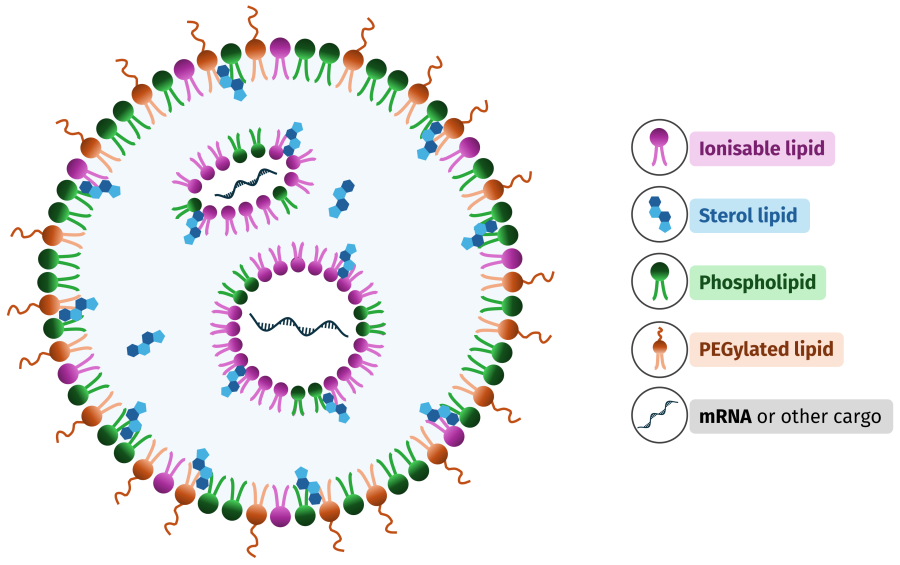
Lipid nanoparticles (LNPs) are the key lipid-based delivery for mRNA therapeutics, utilised for delivery of the mRNA into the body providing protection against degradation, allowing for cellular uptake and subsequent therapeutic function. LNPs are typically comprised of four key components, depicted in the following illustration: an ionisable lipid (or cationic lipid), cholesterol (or other sterol lipid), phospholipid and PEGylated lipid.
Ongoing challenges for development of new and improved LNP formulations for mRNA therapeutics efficacy and utilisation include: reducing side-effects, enhancing targeted biodistribution, improving solubility and transport of therapeutic across membranes for increased bioavailability and transfection efficiency, increasing stability for cellular delivery improvements and cold-chain dependency for storage and supply-chain logistics for global distribution.
Lack of access to high-quality and high-purity deuterium-labelled (2H) LNP components hinders the ability of academic researchers and industry to undertake tracing studies or investigate the structure and function of LNP drug delivery vehicles under a range of conditions using multiple characterisation techniques. These components are particularly useful for application with neutron scattering experiments, where the isotopic substitution provides contrast which enables a higher quality and quantity of experimental data to be collected.
The NDF has leveraged their expertise in applying chemical and biological techniques in deuteration of a wide range of compounds, to be the only facility worldwide able to provide the access and capabilities for provision of the deuterated versions of many of the lipids utilised in currently employed LNP formulations for mRNA delivery and other lipid-based drug delivery systems. This critical onshore capability demonstrates the real-world impact able to be driven by sustained investment in sovereign research infrastructure.
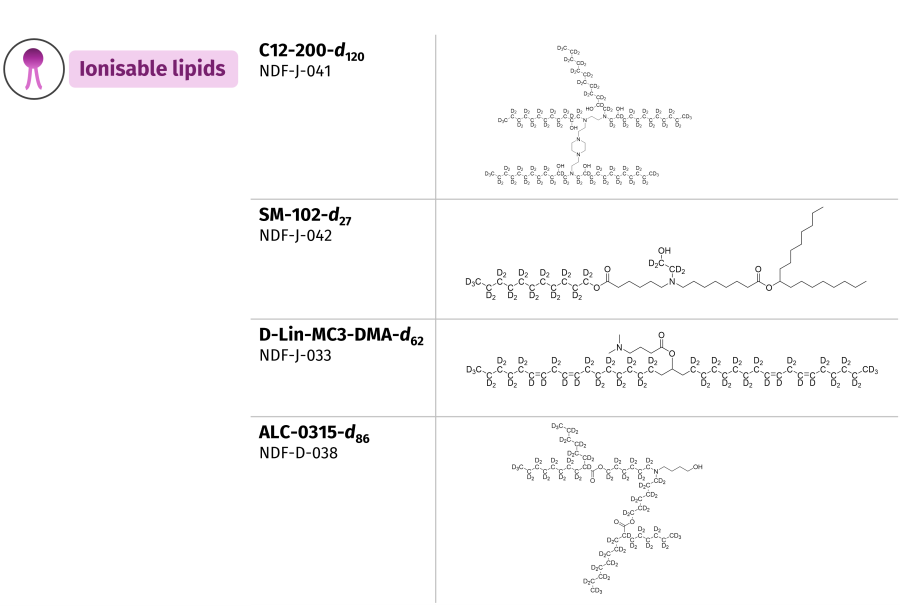
Ionisable lipids
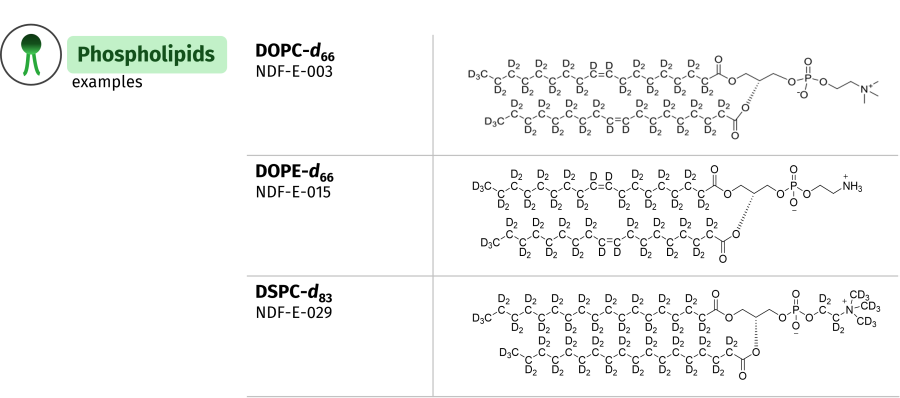
Phospholipids
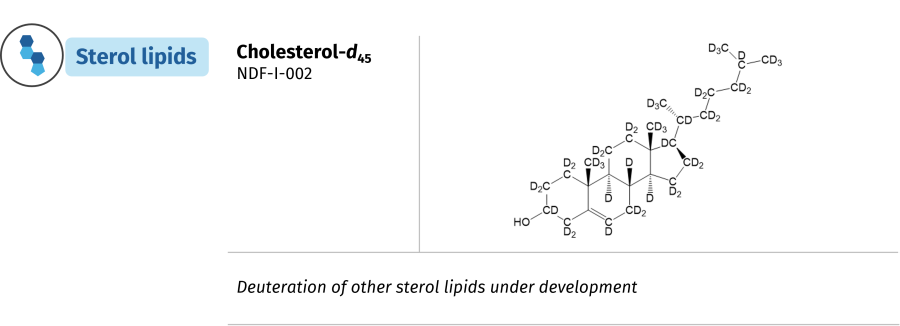
Sterol lipids
PEGylated lipids
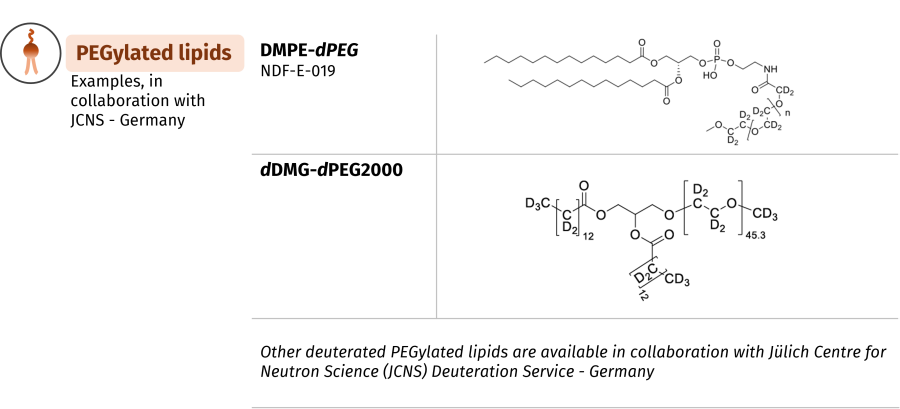
Multiple custom-made deuterated lipids, of which many are not commercially available, have been supplied by the NDF to researchers and industry from each of the four typical LNP key components. The effect of different specific lipids and proportions can be studied which are able to change LNP properties such as size, structure, stability, rigidity, biodistribution and efficacy and influence how properties may change under different conditions for clinical application and storage.
Research studies supported by the application of NDF produced compounds have provided insights which help researchers to design safer and more effective mRNA vaccines and therapies, with studies focussed on areas such as LNP structure, stability, intracellular delivery mechanism and behaviour.
Deuterated cholesterol (cholesterol-d45) produced by the NDF has been utilised in several neutron scattering experiments at both the Australian Centre for Neutron Scattering (ACNS) and international neutron facilities, investigating various aspects of LNPs such as stability and structure. The utilisation of deuterated cholesterol and other deuterated lipids enable experiments not otherwise possible without availability of these deuterated molecules.
Studies have included investigation of cholesterol exchange between LNPs [1] using time-resolved small-angle neutron scattering (SANS), demonstrating LNPs are not static, with cholesterol exchanging in a pH dependent manner, providing a new quantifiable metric for evaluation of LNP formulations and insight into behaviour for optimising stability and delivery. Utilising DSPC-d83, deuterated cholesterol and contrast variation SANS, mRNA-loaded LNP internal architecture was examined highlighting how hydration and pH-responsiveness are key factors influencing mRNA delivery efficiency and stability [2]. Binding of apolipoprotein E (ApoE), responsible for fat transport in the body, with mRNA-LNPs has been shown to affect LNP lipid component distribution and overall LNP structure through neutron experiments and selective deuteration, including application of NDF produced cholesterol-d45 [3]. Lipids were shown to be redistributed upon ApoE binding at both the LNP surface and within the core, important for understanding mechanisms governing mRNA delivery and endosomal escape. The stability of mRNA-LNPs is critical for both storage and distribution logistics and within the body for targeted therapeutic cellular delivery, minimised toxicity and optimised efficacy. Research led from Princeton University utilised multiple deuterated LNP components produced by the NDF: the ionisable lipid DLin-MC3-DMA-d62, cholesterol-d45 and DSPC-d83, to investigate post-loading of empty LNPs with mRNA [4]. Equivalent cellular delivery performance was shown between post-loaded and co-precipitated (conventional practice) LNP formulations, enabling potential for improved vaccine accessibility with adoption of a post-loading strategy, decoupling LNP manufacture from RNA loading and reducing reliance on current extreme cold-chain storage and delivery requirements to improve global vaccine distribution and accessibility.
References:
[1] Hilburg, S.L.; Sokolova, A.; Cagnes, M.; Pozzo, L.D. J. Colloid Interface Sci. 2025, 677, 387–395.
[2] Liu, H.; Vidallon, M.L.P.;…; Wang, X. SMALL STRUCT. 2026, 7, e202500636
[3] Sebastiani, F.; Arteta, M.Y.;…; Cardenas, M. ACS Nano 2021, 15, 6709-6722
[4] Bizmark, N.;…;Warr, G.G; Prud’homme, R.K. bioRxiv 22 July 2026