

The Challenge
Lithium metal batteries could store far more energy than today's lithiumion batteries, making them promising for electric vehicles, portable electronics and grid-scale energy storage. However, during charging, metallic lithium can form needle-like and porous structures known as whiskers, moss and dendrites at electrode surfaces. These structures increase surface area, accelerate unwanted reactions, consume active lithium and can cause short circuits or catastrophic failure. Until now, researchers lacked a non-destructive way to directly measure how lithium structures grow, dissolve and transform inside working batteries under realistic operating conditions.
The Solution
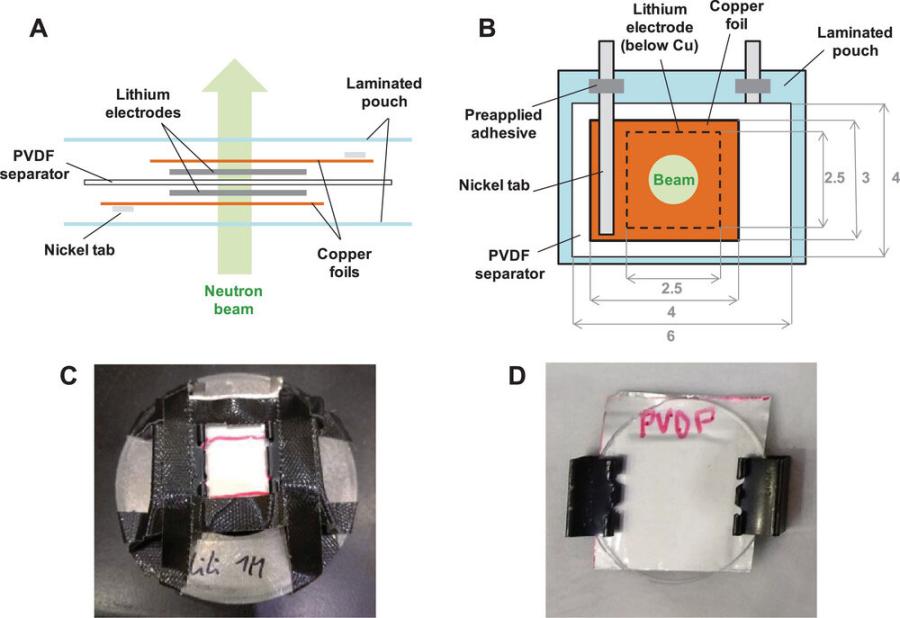
This ANSTO-led study demonstrated that ultra-small-angle and small-angle neutron scattering can directly measure metallic lithium deposits inside working lithium metal batteries without the need to dismantle the cell. The team studied symmetrical pouch cells during charging and discharging, isolating the lithium across a large electrode area that was representative of the whole battery. The measurements of the surface area and average distances between lithium-electrolyte interfaces revealed features at micrometre and nanometre length scales. Importantly, the smaller structures contributed most of the total lithium surface area, and their size and surface area changed with current density and cycling history. This data revealed insights into how damaging deposits evolve with powering up and down the batteries.
The Impact
This work provides a powerful new way to study one of the key barriers to safer, higher-energy rechargeable batteries. By measuring lithium growth non-destructively inside operational cells, researchers can now investigate how current, charge duration and repeated cycling affect the formation of structures and irreversible surface changes. This knowledge is essential for designing lithium metal batteries that are safer, longer-lasting and more reliable for transport, electronics and clean-energy storage. The approach also demonstrates how ANSTO's neutron scattering capabilities can solve applied energy-storage challenges that are difficult to address using microscopy, X-ray imaging or gas adsorption alone.