

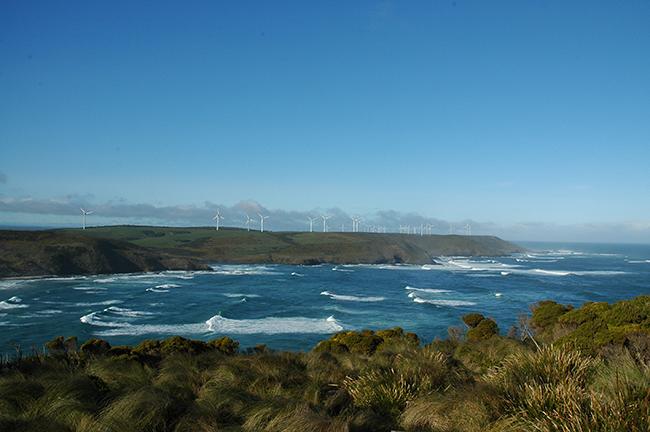
Kennaook/Cape Grim is one of the three premier Baseline Air Pollution Stations in the World Meteorological Organization Global Atmosphere Watch (WMO-GAW) network. The station is a managed jointly by the Bureau of Meteorology and CSIRO.
Kennaook is the recorded name of the cape for the Peerapper people who lived in northwestern Tasmania.
Kennaook/Cape Grim Baseline Air Pollution Station, established in 1976 on the west coast of Tasmania at latitude 40°41’S, provides one of the world’s most important long-term records of the composition of clean Southern Hemisphere air.
The station celebrated its 50th anniversary with an event last week.
Air reaching Kennaook/Cape Grim has travelled thousands of kilometres across the Southern Ocean, far from the sources of human pollution, making it some of the most pristine air on the planet.
Measurements undertaken there, as well as air and aerosol samples taken for later analysis, provide unique insights into atmospheric composition including revealing long-term changes in the amounts of pollutants, including ozone depleting substances and greenhouse gases.
ANSTO has been collecting radon data using its own radon detecting technology since 1980 and fine particle pollutant collecting technology since1990. The information provides a baseline and unique evolving environmental record of the changing atmospheric composition in the Southern Hemisphere.
The Aerosol Sampling Program at ANSTO determines fine particle source fingerprints, over 25 elements, and their contributions to total mass of particulate matter smaller than 2.5 microns.
Radon measurements
Over the last 30 years, ANSTO has been taking radon measurements at the station using a technology it designed and developed, that is recognised by the World Meteorological Organisation as the best in the world for global and atmospheric compositional baseline studies. It is used by leading environmental monitoring networks, universities and Metrological Institutes around the world.
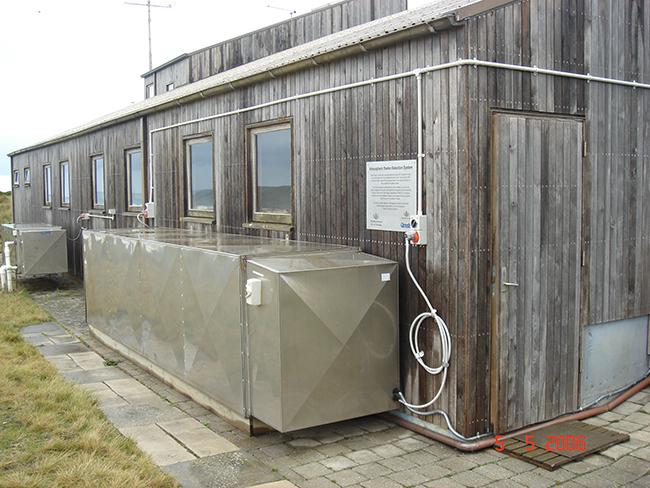
The information has been used for a wide variety of research studies, including tracing air mass movements (including the transport of pollutants and nutrients) and air mass history, such as distance and type of surface the air travelled over. The use of radon as an atmospheric tracer provides a means to check and improve estimates of how much of certain gases are being emitted across a large region and the ability to distinguish between aerosols of terrestrial and oceanic origin.
The data is also useful to evaluate how accurately computer models simulate the movement and mixing of air, and the substances carried in it, through the atmosphere.
The radon monitoring program at Keenaook/Cape Grim is closely associated with radon programs at other sites in the WMO’s Global Atmosphere Watch (WMO‐GAW) network and European Integrated Carbon Observing System (ICOS) network.
In February 1980, a co‐operative program commenced between CSIRO and the Australian Atomic Energy Commission (AAEC), the predecessor of ANSTO, to measure radon and its decay products in the atmosphere at Cape Grim and an early model radon detector was installed.
A two-filter radon detector was operational in 1981. This technology drew air through a coarse membrane filter to remove airborne particulates. All the existing (ambient) radioactive decay products (daughters) of radon (222Rn) and thoron (220Rn) gases were then removed before the sample air moved into the detector. Inside the detector some fresh radon decays under controlled conditions and a second filter captures these new decay products for measurement.
Over the years, there were many enhancements and improvements to the technology that led to the primary radon detector, HURD‐3, which is currently in operation. It is a 5000 L dual‐flow‐loop two‐filter style detector with eight measurement heads to detect α‐particles running in parallel.
ANSTO also collaborates with leading international researchers using long-term observations of radon around the world to validate and improve the performance of transport and mixing schemes of global chemical transport models such as GEOS-Chem.
The unique capabilities of ANSTO’s two-filter dual flow-loop radon monitors make them the only radon detectors currently available worldwide that are capable of identifying air that has been in long-term contact with the remote ocean surface, or air that has come to the surface after spending long periods in the upper atmosphere. This enables some unique analyses of atmospheric composition.
The Aerosol Sampling Program
The Aerosol Sampling Program (ASP) at ANSTO has been operating continuously at Kennaook/Cape Grim since 1992, providing one of the longest records of fine particle composition in the Southern Hemisphere. Cape Grim is one of a network of ASP monitoring locations across Australia where aerosol sample are collected.
The program monitors microscopic airborne pollution known as PM2.5, particulate matter with diameters smaller than 2.5 micrometres. These tiny particles are 40 to 50 times smaller than the diameter of a human hair and pose a threat to the environment and human health.
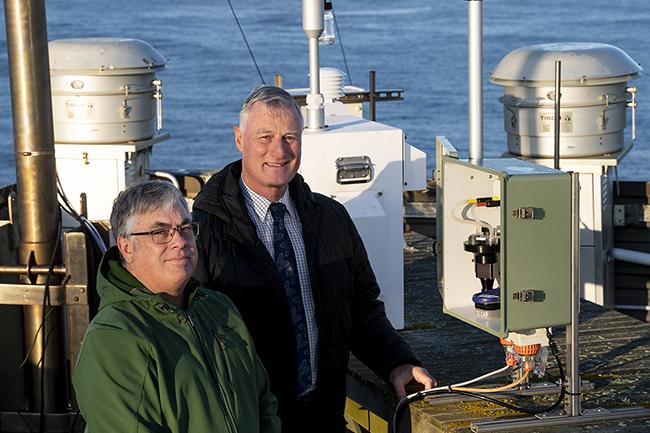
The particles are collected on specially designed 25mm diameter stretched Teflon filters and analysed monthly at ANSTO’s Centre for Accelerator Science using accelerator-based Ion Beam Analysis (IBA) techniques on the 2MV STAR accelerator.
In 1995, ASP scientists began combining the ion beam analysis measurements with a statistical technique, Positive Matrix Factorisation (PMF), to identify sources where the collected PM2.5 are likely to have come from based on their elemental composition. This was the first time in Australia that IBA was combined with the technique to determine fine particle source fingerprints.
Accelerator-based IBA measurements provide the concentration of over 25 different elements and chemicals including hydrogen, carbon, nitrogen, oxygen, sodium, aluminium, silicon, phosphorous, sulfur, chlorine, potassium, calcium, titanium, vanadium, chromium, manganese, iron, cobalt, nickel, copper, zinc, selenium bromine, strontium, lead , black carbon, sea salt, organics, soil, ammonium sulfate and ammonium nitrate. This range of measurements allows scientists to identify both natural and human-made sources of fine particles.
IBA techniques are extremely sensitive, capable of detecting concentrations as low as one billionth of a gram per cubic metre of air sampled without destroying the sample.
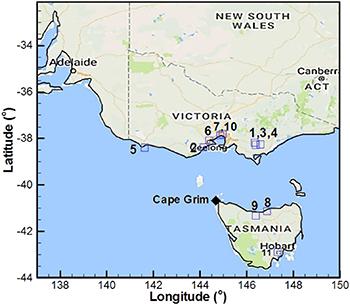
The PM2.5 ASP sampling unit at Kennaook /Cape Grim is located near the station building and samples air from the full 360° around the site. This long-term dataset has enabled scientist to identify contributions from industry in Tasmania as well as several major emitters in Victoria on the mainland of Australia.
An analysis of the full dataset from 1992 to 2023 produced five key source fingerprints: secondary sulfate, sea salt, soil, industrial nitrate and Industrial iron. Of these, sea salt and secondary sulfate were identified as the dominant source fingerprints contributing to the PM2.5 mass measured at Cape Grim.
One example of the program’s value was its ability to detect fine particle pollution transported over long distances. Analysis of aerosol fingerprints combined with atmospheric back-trajectory modelling showed that emissions from Victoria’s 1600MW Hazelwood power station located 302km from Cape Grim in the La Trobe Valley, contributed to elevated secondary sulfate concentrations at the station.
The ASP measurements provided clear evidence of long-range transport of emissions from the Victorian power station to the Cape Grim global base line station.
A study published in Atmospheric Environment by ANSTO scientists analysed long-term fine aerosol measurements at Cape Grim between 1998- 2016 and identified six major source fingerprints: fresh sea salt (57%), secondary sulfate and nitrates (14%), smoke (13%), aged sea salt (the product of NaCl reactions with SO2; 12%), soil dust (2.4%) and industrial metals (1.5%). The study found that secondary aerosol concentrations increased when air masses arrived from mainland Australia, although concentrations remained substantially lower than those measured in more populated regions of Australia.
Over more than three decades of operation, ANSTO’s ASP has continually improved its aerosol sampling hardware, analytical techniques and data analysis methods, including the recent development and application of machine-learning models for data analysis and source identification.
All of the analysed filters collected at Kennaook/Cape Grim are retained in an archive at the Centre for Accelerator Science at ANSTO’s Lucas Heights campus, providing a valuable long-term scientific resource.
The data is available to researchers and authorities on ANSTO's website to support atmospheric and environmental studies
The source of content for this article included The Fine Particle Aerosol Sampling Newsletter Number 52 (August 2023) and A history of measurements at Cape Grim by Alistair Williams and Scott Chambers in Baseline Atmospheric Program (Australia) History and Recollections (October 2016)

