

This year OPAL's 20th Anniversary falls within National Science Week, the perfect time to explore and celebrate the science and technology behind its operation.
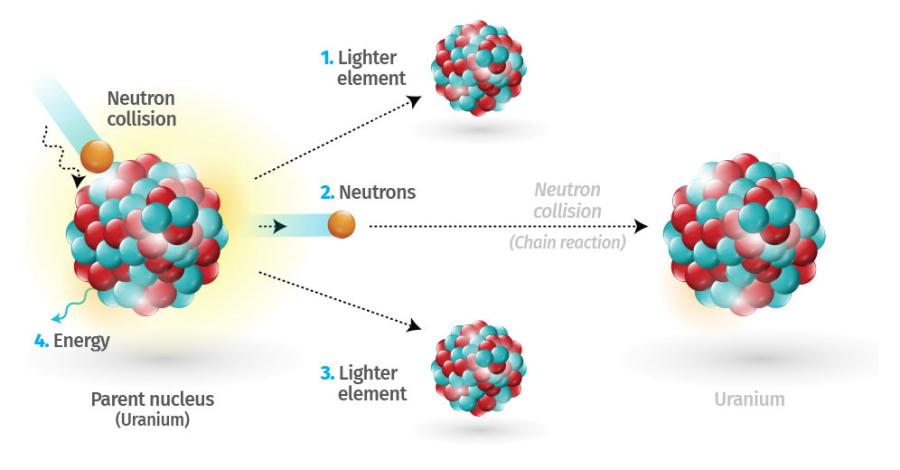
Not all nuclear reactors are the same, although they have some characteristics in common. They are described as ‘nuclear’ because they rely on the use of nuclear technology to manipulate the nucleus of an atom and release its binding energy.
All nuclear reactors are subject to a high level of regulation and safeguards in their respective countries. All operate safely and to the satisfaction of the national regulator.
Australia has one multi-purpose nuclear reactor, the Open Pool Light-Water Reactor (OPAL) and it is not used to generate ‘nuclear power’.
In fact, it is illegal in Australia; prohibited by federal laws and complementary state and territory legislation that bans nuclear power reactors, fuel fabrication and waste processing facilities.
A light water reactor is a type of nuclear reactor that uses purified ordinary water as both its coolant and neutron moderator to sustain the chain reaction. These reactors make up over 95% of all civilian nuclear power plants and research reactors worldwide.
OPAL is also a light water reactor. Its inherent safety features, including redundancy, defence-in-depth and reliance on natural process to stop and cool the reactor—making it one of the best reactors of its type in the world. It is reliable, efficient and productive.
Built for purpose
All nuclear reactors use the process of nuclear fission, the splitting of an atom and the release of radiation and energy, but they are designed for very different purposes. In simple terms, a power reactor is built to produce large amounts of heat for electricity generation.
A research reactor is built primarily to produce useful sub-atomic particles, neutrons, for scientific, medical and industrial uses. A multi-purpose reactor, such as OPAL, is described as a neutron factory—producing (1.5 x10¹⁸) neutrons per second.
Within the OPAL pool at it base, beams of neutrons are guided to a suite of sophisticated scientific instruments at the Australian Centre for Neutron Scattering. Researchers using these powerful non-destructive scientific instruments to reveal information about the structure and motion of materials at the atomic scale.
The facility delivers research outcomes for a vast array of scientific disciplines and industry applications: medicine, food, engineering and construction, mining, advanced technologies, energy materials, palaeontology, cultural heritage items, planetary and space studies, and much more.
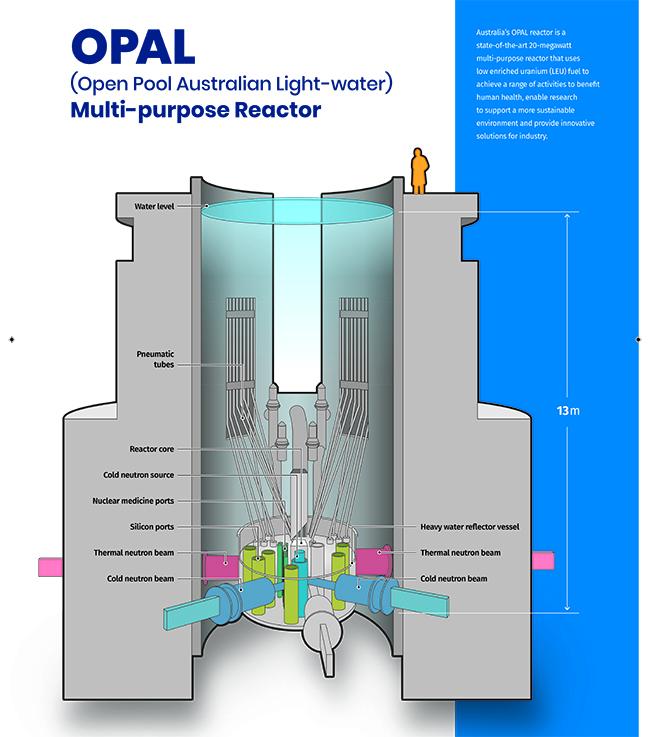
Within the reflector vessel in the OPAL pool, there are also locations for irradiation activities, including producing radioisotopes and irradiating silicon.
In OPAL, plates of uranium are irradiated. These plates are then chemically processed in a separate facility to remove molybdenum-99, the precursor of technetium 99m, one of the most commonly used medical diagnostic radioisotopes.
In contrast, a power reactor is designed to generate electricity. It also produces heat through nuclear fission but uses that heat efficiently to make steam. The steam drives turbines, which then generate electrical power.
A large commercial reactor may generate around 1000 megawatts of electricity or more.
Research reactors and multi-purpose reactors still require cooling, shielding, control and safety systems, same as power reactors but do not have the power generation infrastructure of a power station.
The features of non-power reactors include irradiation channels, beamlines or neutron guides, hot cells, isotope production facilities, service pools and experimental rigs.
How much heat is produced?
Power in a research or multi-purpose reactor is usually described in terms of thermal power, from a few kilowatts to tens of megawatts, with some larger research reactors reaching around 100 megawatts thermal.
The OPAL multi-purpose reactor produces 20 MW of heat or thermal power.
Power reactors, such as the Westinghouse AP1000 typically operate at 3000 megawatts of thermal power.
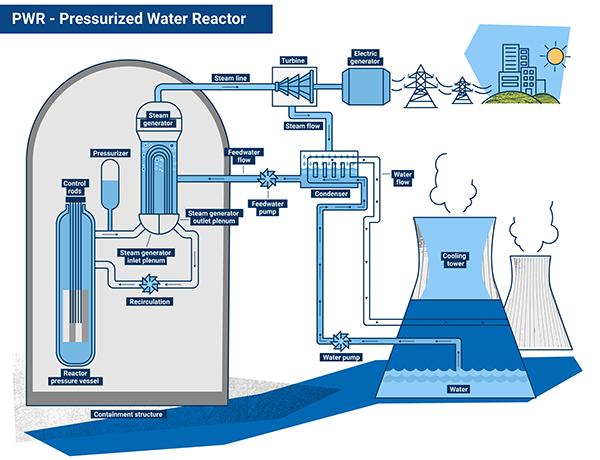
Power reactors are large industrial facilities. They contain large reactor cores, major high pressure cooling systems in containment vessels, with steam generators, turbines and the infrastructure to generate electricity and grid connection in an adjacent plant.
They operate at high temperatures so they can produce steam efficiently. For example, pressurised water reactors operate with water at more than 300°C under high pressure.
A steam generator is part of the cooling system in some nuclear power reactors, such as pressurised light water reactors. Hot water from the reactor passes through the steam generator and heats a separate supply of water. This second water supply turns into steam, which drives turbines.
The steam is then condensed back into water and recirculated to the reactor or heat exchanger.
The two water circuits do not mix. This helps keep the water from the reactor separate from the water that becomes steam.
A steam generator transfers heat from one system to another.
Power reactors are usually designed around efficient heat transfer, long-term electricity production and safe operation at high power.
A non-power reactor operates at lower temperatures. Heat is more of a by-product. However, the reactor still needs cooling.
Many pool-type research reactors are cooled and moderated by water at much lower temperatures, often below boiling point.
Differences in the fuel
Power reactors usually require large quantities of uranium fuel. A large reactor may contain many tonnes of uranium.
In common power reactors such as the Westinghouse AP-1000, the fuel is typically uranium oxide ceramic pellets placed inside zirconium alloy tubes, which form fuel rods and fuel assemblies.
Research reactors use much smaller amounts of fuel than power reactors, often only a few kilograms.
Power reactors generally use low-enriched uranium, commonly enriched to about 3.5–5% uranium-235.
Power reactors produce larger volumes of used fuel because they contain much more uranium and operate at much higher total power. This used fuel produces significant decay heat and requires long-term cooling and management.
Many modern non-power reactors, including OPAL, use uranium enriched to below 20% uranium-235, known as high-assay low-enriched uranium.
Research reactors produce much smaller quantities of used fuel. The used fuel may still be highly radioactive, but it usually produces less decay heat because the total amount of fuel is much smaller.
In terms of security and nuclear safeguards, this is a distinct advantage as low enriched uranium fuel is far less likely to be subject to proliferation.
In conclusion, although they share some common characteristics, power and non-power reactors are by design and purpose, very different technologies.
Research reactors can be found in cities and university campuses. Whereas large power reactors are typically located on the coast to enable access to large volumes of cooling water.
There are over 220 operational research reactors around the world in some 50 countries.
The World Nuclear Association estimates there are about 440 nuclear power reactors operating in 31 countries today.
Nuclear reactors also come in other numerous other types and sizes, including small modular reactors.
Content sources for this article included the International Atomic Energy Agency, World Nuclear Association and the Nuclear Energy Agency (US). More information is available on their websites.
