Research led by a group from the University of Newcastle has found a new way to make silicone surfaces – and have even discovered that they can control how slippery they are. This work has been published this month in the journal Chemistry of Materials.
Most of us have silicone in our homes, especially in the kitchen, it is often found as a rubbery coating that is usefully long-lasting, water-repellent and crucially—slippery. Scientists have also wanted to make use of it at the nanoscale, where silicone has a big potential to reduce the friction of surfaces at this tiniest scale for use in medical devices and beyond.
Because silicone is made up of long molecules, known as polymers, scientists have hoped to make surfaces where these molecules are gathered like a brush. But silicone brush surfaces have been very hard to make and, critically, to control the surface properties.
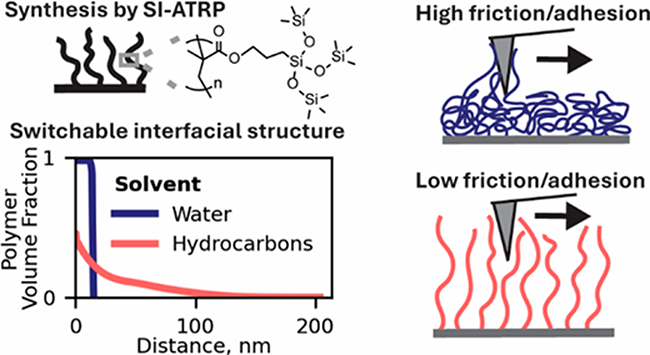
Using a controlled manufacturing technique called surface-initiated controlled polymerisation, the team grew exceptionally smooth and uniform silicone brush layers. The thickness of the brushes could be tuned from only a few nanometres to more than 70 nanometres.
A key discovery was that the structure of these brushes changes dramatically depending on the surrounding liquid. In water and simple alcohols, the polymer chains collapse tightly against the surface. In liquids such as toluene and hydrocarbons, similar to those found in lubricants, the chains take up solvent and extend away from the surface, creating a thicker, softer layer.
To confirm their discovery, the researchers combined neutron reflectometry on the Platypus instrument at the Australian Centre for Neutron Scattering with ellipsometry and atomic force microscopy measurements. Together, these techniques showed how the brushes ‘grew’; how their internal structure responded to different liquids, and how those changes affected friction and adhesion.
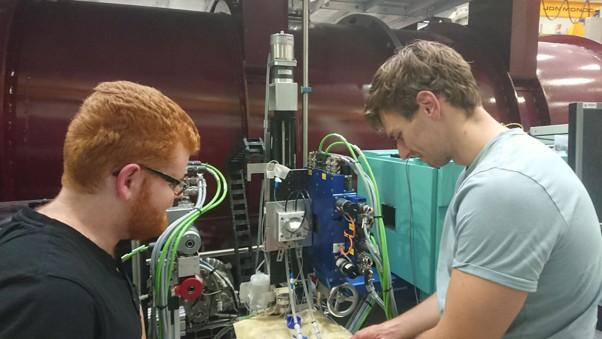
Neutron scattering was essential to explain this behaviour. Neutron reflectometry directly revealed how the polymer brush nanostructure changes in different environments, providing the missing structural insight needed to understand the unusual lubrication response,’ said Principal investigator of the work Dr Edwin Johnson from the University of Newcastle
The work also demonstrates ANSTO support of early career researchers. First author Zachary Di Pietro put his scholarship work towards ultra-low-friction materials to use with access to both instrument time and world-leading expertise at the Australian Centre for Neutron Scattering Zachary also holds an AINSE Post Graduate research award.
The group also discovered that these surfaces can be produced on a larger scale to provide a platform for designing switchable silicone surfaces whose friction and stickiness can be adjusted by changing the surrounding liquid. Such coatings could contribute to improved lubrication, advanced industrial finishes, low-fouling surfaces, medical technologies and microfluidic devices. More broadly, the study demonstrates how understanding and controlling materials at the nanoscale can lead to smarter surfaces that adapt their behaviour as conditions change.
DOI: https://doi.org/10.1021/acs.chemmater.6c01842