New international best practice guidance, co-written at ANSTO, sets out how to measure where nanoparticles like titanium dioxide end up in the body and how long they remain.
The advisory has been shared by the Organisation for Economic Co-operation and Development (OECD), a forum and knowledge hub for data, analysis and best practices in public policy.
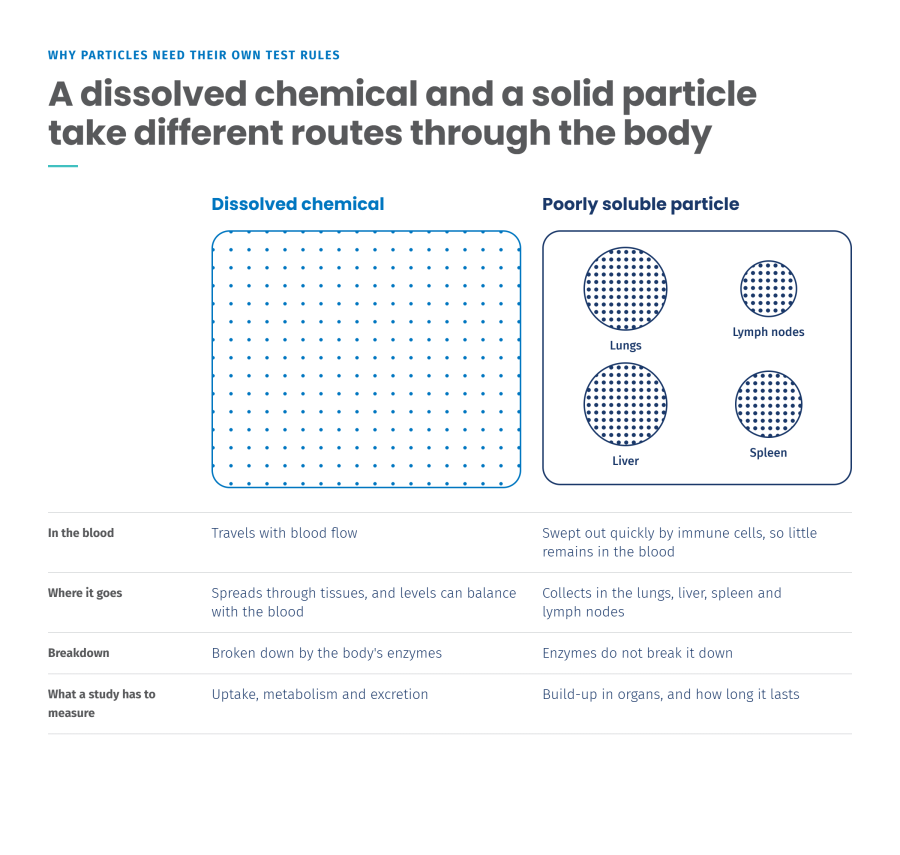
Scientists have well-established ways to measure how a dissolved chemical is absorbed, distributed and cleared by the body. The OECD test guideline for those studies was first adopted in 2010. It was written for chemicals that dissolve, and states that it is not intended for nanomaterials.
Poorly soluble nanoparticles are harder to follow. Once they reach the bloodstream, many are rapidly taken up by immune cells that clear foreign material, so very little ever shows up in a blood sample. The nanoparticles collect in a few organs, mainly the liver, spleen, lungs and lymph nodes, and can stay there for months or longer.
The OECD has now published guidance for how we can test the safety of nanoparticles that are taken up within our bodies. Its Guidance Document on Toxicokinetics to accommodate Testing of (Nano)particles sets out how researchers should design, conduct and report studies of nanoparticles that are swallowed or inhaled. ANSTO's Dr Paul Callaghan was part of the core expert group that wrote it, and the only member from the Southern Hemisphere.
Titanium dioxide, a white pigment used in food for decades, is a good example of why guidance was needed. When used as a food additive, we absorb very little of what we swallow, probably no more than 0.5 per cent, according to the European Food Safety Authority (EFSA). Even so, the nanoparticles have been detected in human liver and spleen and working out how quickly they leave the body has proved difficult.
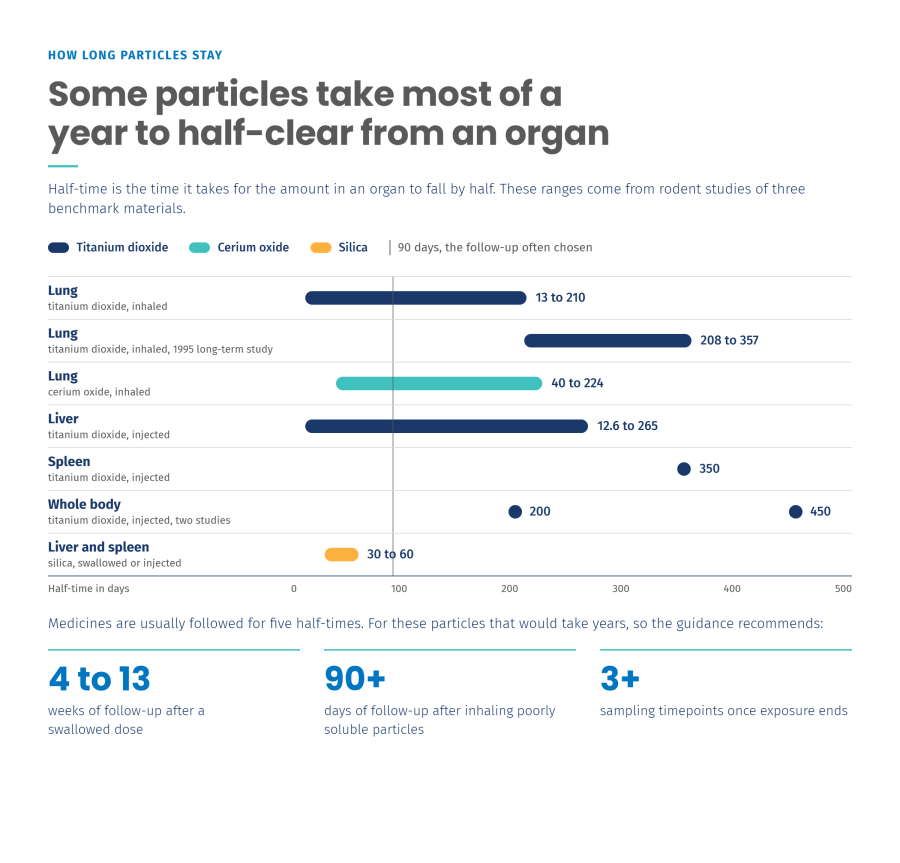
Any assessment about whether a nanoparticle like this is safe depends on knowing where it goes in the body, how much builds up and how long it stays. As an example, we can see how variable clearance of these nanoparticles can be in animal studies by looking at three nanoparticles humans are commonly exposed to, containing titanium, cerium and silica.
Two animal studies injected the same 21-nanometre particles and came up with very different half-times, the time it takes for the amount in the liver to fall by half. The result was 95 days in one and 265 in the other, which could mean it could take years to clear these particles from the body. Most of the feeding studies did not follow the animals for long enough to calculate a half-time at all. The OECD guidance provides information about how to measure those things reliably.
EFSA and French Agency for Food, Environment and Occupational Health Safety (ANSES) both published statements in 2019 indicating uncertainties and data gaps in existing toxicology studies meant the previous conclusions on the safety of titanium dioxide as a food additive could not be upheld. It was not evidence of toxicity that was the concern per se, rather a lack of appropriately designed toxicological safety tests to directly demonstrate toxicity. The need for appropriate documentation that advises how the ‘nano’ form of a particle behaves differently in how it is absorbed, broken down, and cleared from the body, and how toxicity tests should take this into account was needed. The Guidance Document on Toxicokinetics to accommodate Testing of (Nano)particles is targeted to this need.
Finding the nanoparticles within the body is the other challenge. Titanium and silicon are already present in tissue and in animal feed. When only a tiny fraction of a dose in our food reaches the liver, separating it apart from the background can become the hardest part of the experiment. Of the methods the guidance reviews, one of the most sensitive is radioactivation, in which the particle itself is irradiated so that some of its atoms become radioactive and can be followed through the body.
Because nothing is attached to the particle's surface, its properties are less likely to change, and there is no label to come loose. The guidance rates the method as suitable for studies of up to 90 days.
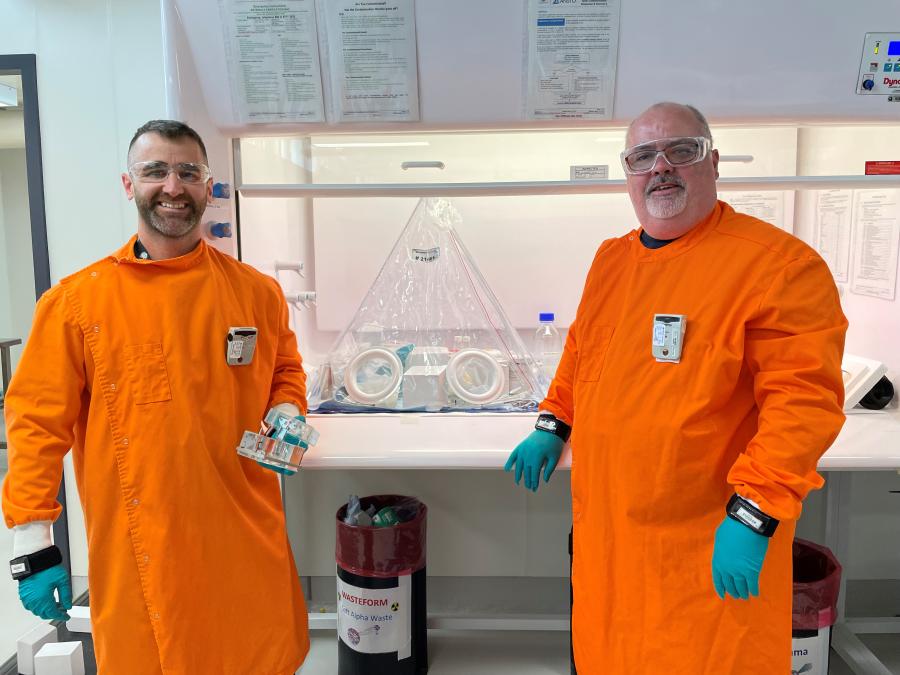
"Finding the nanoparticles within the body is like tipping a handful of sand onto a beach and then trying to pick out your own grains," Dr Callaghan said. "The titanium we administered looks the same as the titanium that was already there. If you radiolabel the particles first, the nanoparticles of interest are the only grains that light up."
Dr Callaghan has led a team of researchers at ANSTO’s Health Research and Technology Group, Nuclear Materials Research and Technology Group, and Sir Charles Gairdner Hospital (Perth, WA) who used radiotracers to study how titanium dioxide from food builds up in animal models. He joined the OECD project, which began in 2024 and was co-led by the Netherlands and the United Kingdom, following on from the European Horizons research program NanoHarmony.
The guidance is advisory: the group set out to write a formal OECD Test Guideline and decided in 2023 that this was not feasible. It covers simple, manufactured particles that are swallowed or inhaled. Fibres, skin exposure and nanomedicines are outside its current scope.
"Dr Callaghan’s contribution shows how far ANSTO's expertise can reach," said Dr Mitra Safavi-Naeini, Director of ANSTO's Health Research and Technology Group. "We have nuclear techniques that can solve measurement problems that are extremely difficult by other means. In this case, that expertise has helped shape how laboratories around the world design and interpret these studies."
The OECD Guidance Document on Toxicokinetics to accommodate Testing of (Nano)particles is freely available at:
https://doi.org/10.1787/629332c6-en.