Powder diffraction is the bread-and-butter method of neutron scattering, and one in which Australia has long had significant strength. Neutron powder diffraction is particularly useful for materials with light elements in the presence of heavy ones (e.g. oxides, borides, carbides, etc.) and for magnetic materials, for example, materials such as superconductors, pharmaceuticals, aerospace alloys, cements, minerals, zeolites, hydrogen-storage media and optical materials.
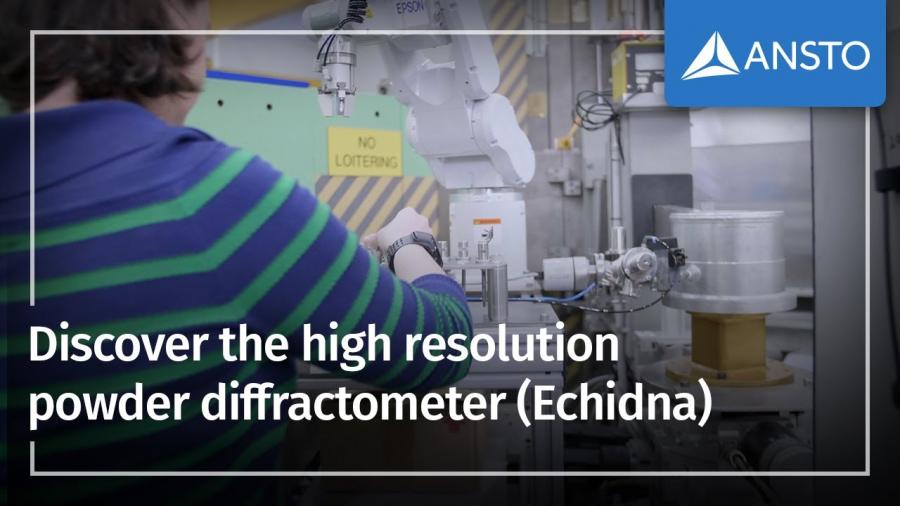
We have two world-class powder diffractometers: Echidna high-resolution powder diffractometer; and WOMBAT high-intensity diffractometer. Echidna is optimised for structure determination of new materials. The instrument uses a single wavelength and a highly collimated neutron-beam to improve resolution.
This diffraction technique can accurately resolve both complex atomic and magnetic structures. Relevant fields of study using Echidna are solid-state physics, materials science, chemistry, geosciences, and engineering.
The instrument is named after the Australian mammal echidna (Tachyglossus aculeatus).