

The Challenge
Can we make molybdenum-99 (Mo-99), an important medical radioisotope in a more sustainable way? Mo-99 decays to technetium-99m (Tc-99m), the most commonly used nuclear medicine to diagnose heart disease and other illnesses. Part of ANSTO's core mission is to produce this important product, which is distributed safely in Gentech® Generators nationally and internationally. However, the current production process is based on a technology developed decades ago. The current multi-step process of dissolving targets, the source materials, can lead to a low yield and creates undesirable fission products as waste. The more economical production of Mo-99 with less uranium-235 (U-235) in targets and the production of less waste would have a great benefit to Australia.
The Solution
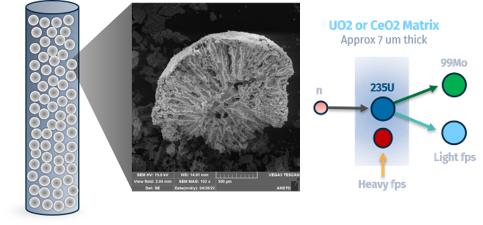
A team from ANSTO and the University of Wollongong has capitalised on existing knowledge and Mo-99 production, nuclear fuel and the fission of U-235 to develop improved targets. Previous work, which gained a provisional patent, focused on modelling to determine yields from a porous reusable target. The next stage is under way with proof-of-concept experiments involving the fabrication and irradiation of simulated targets. These targets have been designed using a fraction of U-235 (1-2%) as compared to current low enriched uranium targets (20%). They eject Mo-99 when the U-235 undergoes fission, removing the need to dissolve the target and allows Mo-99 it to be flushed out. Reuse consumes all the U-235. In parallel, the team is working on applying the technology to acceleratorbased systems that could be implemented on a much smaller scale than current reactor-based systems.
The Impact
This project not only protects Australia's sovereign capability to produce Mo-99 but future-proofs it against competing technologies in the worldwide marketplace. ANSTO will be able to produce Mo-99 more economically, while producing less waste. It may be possible to also make the targets at the Lucas Heights facility and reduce the cost of Mo-99 production significantly.