
The Challenge
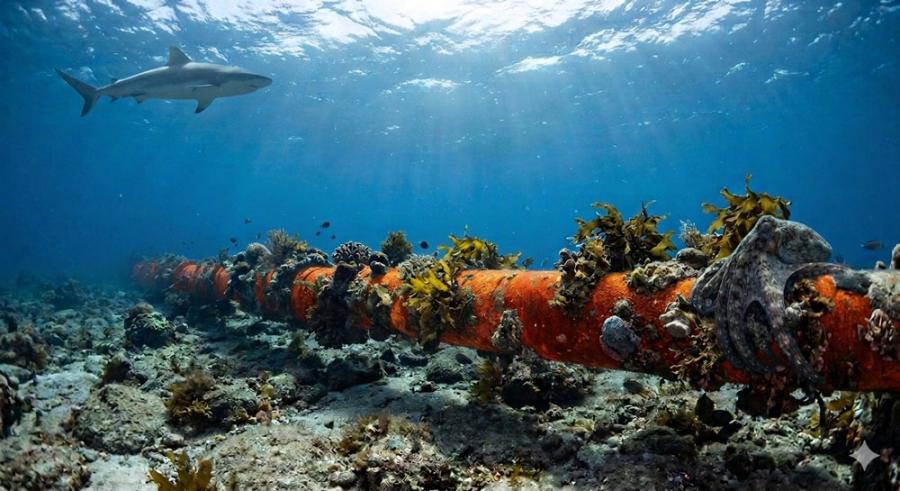
Australia is one of the largest exporters of natural gas globally, with a substantial proportion of oil and gas being extracted offshore from our continental shelf At the end of operational life, all infrastructure is required by law to be removed unless a case can be made that the risks are as
low as reasonably achievable. Contaminants on the internal surfaces of production infrastructure (i.e. pipelines), including naturally occurring radioactive material (NORM) and mercury, may represent a risk to Australia's marine ecosystem that should be assessed before impacted infrastructure can be left on the seabed.
The Solution
ANSTO is leading research to characterise contaminants from oil and gas production. This is improving our understanding of how such contaminants behave in Australia's marine environment, and how they may interact with and potentially impact Australia's marine ecosystem and fisheries. This is achieved through two scientific pathways: 1) using cutting-edge nuclear science based testing capabilities in specialist laboratories at ANSTO to provide a detailed understanding of the concentrations, chemistry and composition of contaminants to capture potential leaching in seawater and potential bioavailability and 2) using bespoke radioisotope tracers
of mercury produced using the OPAL research reactor to understand the potential chemical transformations and bioaccumulation of mercury
by Australian marine organisms. This information guides an informed assessment of ecological risk and allows for robust environmental management decisions to be made.
The Impact
Research findings and analytical testing results have been used by both industry and government stakeholders to provide critical information about the long-term impacts of residual contaminants from decommissioned subsea pipelines. Industry can better plan their decommissioning process, while regulators can accurately assess potential impacts of contaminants within offshore infrastructure. The team has co-developed a contaminant risk assessment framework specific for Australian offshore infrastructure and has worked with international bodies, including the IAEA, to develop technical reports outlining best practice management of NORMcontaminated production infrastructure.
Australian Research Priority or Futures Made in Australia Framework
- Protecting and restoring Australia's environment
ANSTO strategic priority
- Deliver on Australia's priorities for the benefit of people, industry and the environment
ANSTO capability capability/ instrument
OPAL
Vivarium
Australian Synchrotron
XFM
X ray Fluorescence Microscopy
XAS
X ray Absorption Spectroscopy
SEM, TEM
Gamma & Alpha Spectrometry
CV-AFS
Collaborators/clients
- Multiple Industry partners
- NOPSEMA, DCCEEW and DISR
- Australian Institute of Marine Science (AIMS)
- La Trobe University
- Australian National University
ANSTO contributors
- Dr Francesca Gissi
- Dr Alexandra Boyd
- Minerals
- Radiation Services
- Health Research and Technology group
Paper DOI
Contact
Dr Tom Cresswell
Tom.Cresswell@ansto.gov.au