
Diversity, Equity, Inclusion and Belonging
At ANSTO we understand that diverse teams produce better outcomes – and we value the merit that a diverse perspective can bring to the quality and outcomes of our work, and the way we get the job done.


Showing 321 - 340 of 535 results
At ANSTO we understand that diverse teams produce better outcomes – and we value the merit that a diverse perspective can bring to the quality and outcomes of our work, and the way we get the job done.

ANSTO offers a broad range of programs and services to various industries and customers. Many of these services, including the Australian Nuclear Medicine Traceability program, are supported by online customer portals.

The Think Science! event encourages students to engage with the Science Inquiry Skills process as outlined in the Australian National Curriculum.


In partnership with the Australian Museum as part of National Science Week explore the 2020 hackathon theme of Deep Blue: Innovation for the future of our oceans

Professor Christine Thong leads the academic direction for Design Factory Melbourne at Swinburne University and is involved in a range of teaching, research and strategic initiatives.

ANSTO researchers are investigating nuclear propulsion systems for applications on the sea and in space.
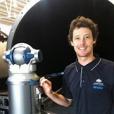
Matt Bell is a technical officer with a background in mechanical engineering. Matt started at ANSTO in 1993 as a Fitter & Machinist apprentice in the Engineering Workshop.

Josh is a passionate individual who loves design thinking and collaborating with others to create innovative solutions from complex problems.

ANSTO and the User Meeting 2024 organising committee celebrate this years award recipients.

The growth and incorporation of graphene into semiconductor device architectures has been limited by challenges related to the quality, reproducibility, and high process temperatures required to grow it on suitable substrates.
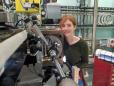
Eleanor is a crystallographer and instrument scientist helping researchers from all over the country use ultra-bright light to answer their scientific questions.
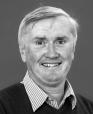
Dean was born in Wales and completed a PhD in X-ray optics at the Daresbury and Brookhaven synchrotrons. His first job was building a surface science beamline at Elettra in Italy.
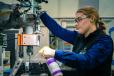
Ready to start a hands-on career? ANSTO’s Apprenticeship Program gives you the chance to earn while you learn, build real trade skills and contribute to work that supports Australia’s leading nuclear science and technology organisation.
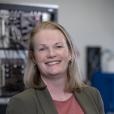

The BRIGHT Project will expand the beamline infrastructure of the Australian Synchrotron to increase both its capacity and capabilities.

Before taking up her appointment at the Australian Synchrotron, Dr Cathy Harland was the ASRP (Australian Synchrotron Research Program) beamline scientist at XOR at the Advanced Photon Source in Chicago.

ANSTO has a variety of games and apps to educate students on how radiation works, nuclear medicine, the periodic table, and atom building.