Diamond for biological sensing applications
Nitrogen-doped ultrananocrystalline diamond (N-UNCD) is a promising material for future biological and electrochemical applications.


Showing 661 - 680 of 1662 results
Nitrogen-doped ultrananocrystalline diamond (N-UNCD) is a promising material for future biological and electrochemical applications.
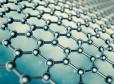
The growth and incorporation of graphene into semiconductor device architectures has been limited by challenges related to the quality, reproducibility, and high process temperatures required to grow it on suitable substrates.

Efficient electro-catalysis of hydrogen from seawater represents a low-cost, abundant source of clean energy.

Experiments undertaken at the Australian Synchrotron have allowed research teams from Monash University and La Trobe University to clarify fundamental aspects of T-cell activation crucial to the body’s immune response to disease.
A large international research team led by Academia Sinica in Taiwan investigated how heat is transferred in an advanced thermoelectric material made with germanium (Ge) and tellurium (Te) and doped with antimony (Sb). These devices are used to power space probes such as the Mars Curiosity Rover.
The Australian Neutron Beam Users Group (ANBUG) presented annual awards to accomplished neutron scientists at the combined ANSTO User Meeting - AUM2023 held in late November 2023.
ANSTO has a new roadmap for future development of its sovereign infrastructure, capabilities and expertise.
Terahertz/Far Infrared beamlines assisted investigation into possible composition of lower atmosphere of Saturn's moon Titan.
On the international stage amongst the leading nuclear nations of the world, Australians hold its own. This status has been earned by ANSTO’s seventy-year history of safe nuclear operations, the application of nuclear science and technology to benefit society and nuclear stewardship role in Australia.
ANSTO provides a range of learning resources for students interested in science or studying for a school project. ANSTO also provides educational school holiday workshops and in-school-term science tours.
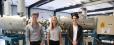
Approximately 200 external users access the accelerators through the merit-based system, in-kind partnerships and pay for service arrangements,
Study helps make carbon dating a more accurate chronological tool.