

Showing 721 - 740 of 1371 results

PIXE
Particle induced X-ray emission can be used for quantitative analysis in archaeology, geology, biology, materials science and environmental pollution.
Optus adopts new Worker Safety App designed by workm8
Building a new neutron reflectometer
A sparrow with 257 parts weighing more than 29 tonnes arrives safely at ANSTO
A new safety shutdown instrumentation and control system for the OPAL multi-purpose reactor
During the scheduled shutdown of the OPAL multi-purpose reactor, an ANSTO engineering and project team has installed a new safety shutdown instrumentation and control system (I&C).

Beamtime guide - SAXS / WAXS
Beamtime guide on the SAX / WAXS beamline at the Australian Synchrotron.
Using ocean water to understand feeding habits of Humpback Whales
Feathery moa’s fossilised footprints, ancient age revealed
ANSTO scientist, Dr Klaus Wilcken of the Centre for Accelerator Science, used cosmogenic nuclide dating to determine the ages of layered sand and gravel samples, in which seven footprints of the flightless bird, the moa, were found on the South Island in New Zealand in 2019.
Excavation of dark matter lab completed
With all excavation completed and rock removed from the underground site, the physics lab will now be built within the caverns of the Stawell Mines site.
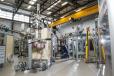
Particle Induced X-ray Emission
Particle Induced X-ray Emission (PIXE) is a powerful and relatively simple analytical technique that can be used to identify and quantify trace elements typically ranging from aluminium to to uranium.
Advanced reactor research: Student opportunity
ANSTO is interested finding students to collaborate on Generation IV reactor systems.
Research to be accelerated with synergistic partnership
Collaboration locates elusive oxygen ions in new solid electrolyte
Study confirms fraudulent Kakadu plum product is in the international marketplace jeopardising authentic Indigenous products
Research confirms that fraudulent Kakadu plum extracts are in circulation online and in the international marketplace.
High achievers join ANSTO Graduate Development Program in 2015
Fish lift
A lift for fish at Tallowa Dam: Study on dietary impacts.

Connect with ANSTO's Women in STEM
Read about an ANSTO scientist and their work to prepare for a school project or interview.

Taipan - Thermal Triple Axis Spectrometer
Taipan is used to study the collective motion of atoms, phonons and magnons in materials, and phase transitions and processes involving thermal energy.
OPAL reactor back online after planned long shutdown
ANSTO’s OPAL multi-purpose research reactor at Lucas Heights has officially returned to power and recommenced operations, following a months-long planned shutdown to carry out essential maintenance and upgrades.