Roadmap for future development of sovereign infrastructure, capabilities and expertise
ANSTO has a new roadmap for future development of its sovereign infrastructure, capabilities and expertise.


Showing 821 - 840 of 1226 results
ANSTO has a new roadmap for future development of its sovereign infrastructure, capabilities and expertise.
Imperial College London researchers tapped into ancient geological data locked within precariously balanced rocks using a new technique to boost the precision of hazard estimates for large earthquakes.
Today an international team has provided a molecular basis for strong immunity against COVID-19.
A study has provided insight into copper sulfate pentahydrate and could give clues to how other hydrated minerals change under the pressures within planetary environments
Using the Australian Synchrotron, an international team of researchers has characterised an important interaction that helps the SARS-CoV-2 virus invade human cells.
Young ANSTO biomedical materials scientist will attend Nobel Laureate meeting.
International study has revealed a clustering of charged particles in the microgravity environment of space,with implications for the development of materials and better drugs that depend on the mixing of two or more charged particles.
Combined users meeting highlights how ANSTO expertise and infrastructure can assist research community.
Australian researchers and clinicians have recently returned from Japan where they investigated the use of advanced radiation therapy for cancer using heavy ions at particle therapy facilities on a study tour .
Doping with transition metals produced stability in bismuth oxide.
Two of Australia’s leading science organisations, ANSTO and the National Measurement Institute (NMI), which share areas of common interest in both measurement and research, signed a MOU formalising collaboration on 6 March 2019.
Sample environments, Data analysis.
ANSTO research focuses on an advanced form of cancer treatment under consideration in Australia.
Research collaboration with University of Sydney focuses on a personalised approach to cancer treatment.
Scandium 47, a therapeutic radioisotope and potential theranostic, has been produced for the first time at ANSTO. Theranostics are used to both diagnose and treat disease.
ANSTO officially thanked the Sir William Tyree Foundation for its support in acquiring the HIFAR reactor control room as an educational resource in the Discovery Centre.
Evidence of the earliest occupation of the coasts of Australia from Barrow Island, Northwest Australia.
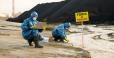
Billions of tonnes of iron ore tailings are generated each year from the mining industry. Converting these toxic tailings into soil-like materials which can develop and sustain plant and microbial communities is critical for mine site remediation and improved environmental outcomes.