
What is synchrotron light?
Synchrotron light is the electromagnetic radiation emitted when electrons, moving at velocities close to the speed of light, are forced to change direction under the action of a magnetic field.


Showing 101 - 120 of 605 results
Synchrotron light is the electromagnetic radiation emitted when electrons, moving at velocities close to the speed of light, are forced to change direction under the action of a magnetic field.
The mechanical, electrical, chemical, optical and thermal properties of glass, as determined by its chemical composition and atomic structure, make it a highly useful material with a myriad of applications.

ANSTO's Minerals team provides consultancy, process development and research services to the mining and minerals processing industries.

ANSTO's Sydney locations are home to the Open Pool Australian Light-water (OPAL) multi-purpose reactor, the Centre for Accelerator Science (CAS), the Australian Centre for Neutron Scattering, the National Research Cyclotron and the National Deuteration Facility.

ANSTO is an experienced provider of Teacher Professional Development for Australian and International teachers and our courses cover a wide range of topics. Hear from expert speakers, receive new education resources, and develop lessons for your own class.
Research makes it possible to assess if and how rocky coasts, which make up the majority of the world’s coasts including Australia and New Zealand, will respond to changes in marine conditions.
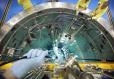
ANSTO addresses key scientific questions in the nuclear fuel cycle for both the current generation of nuclear reactors and future systems.

Applications, Recent results and Publications
ANSTO has been granted a patent in Australia and a number of European countries for the separation, a key radioactive contaminant in critical minerals processing, actinium-227, from process liquors used in minerals extraction.
Understanding how COVID supresses the immune system may lead to antiviral strategies

Australia’s Open Pool Australian Lightwater (OPAL) reactor is a state-of-the-art 20 megawatt multi-purpose reactor that uses low enriched uranium (LEU) fuel to achieve a range of activities to benefit human health, enable research to support a more sustainable environment and provide innovative solutions for industry.

ANSTO researchers are investigating nuclear propulsion systems for applications on the sea and in space.
Stable, highly conductive 2D nanosheets of boron nitride promising new material.
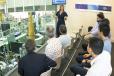
This tour provides an in depth look into the world of nuclear science and the work ANSTO does in the areas of health, the environment and delivering solutions for industry.
Tours are designed for adults and children 8 years and over, and can be booked for groups from Monday to Friday, subject to availability. Groups must be at least 12 people. These are general tours for community groups - if you are a school group, please see our range of syllabus-linked school tours.
Duration: 2.5 hours
Cost: $15 per person
The panel will investigate a wide range of potential effects spanning radiological, environmental, climatic, agricultural, public health, and socio-economic impacts, through a scientifically rigorous and independent lens.
Indigenous Kakadu plum farmers attend workshop on use and application of the elemental fingerprint technology for indigenous bushfoods provenance.