The characterisation of planetary materials
ANSTO provides a range of capabilities using neutrons, X-rays and infrared radiation to study the solids, liquids and gases that might be found in materials in our solar system and beyond.


Showing 181 - 200 of 305 results
ANSTO provides a range of capabilities using neutrons, X-rays and infrared radiation to study the solids, liquids and gases that might be found in materials in our solar system and beyond.
ANSTO provides a range of capabilities using neutrons, X-rays and infrared radiation to study the solids, liquids and gases that might be found in materials in our solar system and beyond.
ANSTO provides trusted advice, training and consultancy services to Australia’s resource sector.

The International Synchrotron Access Program (ISAP) is administered by the Australian Synchrotron and is designed to assist Australian-based synchrotron users to access overseas synchrotron related facilities.

We have provided answers to some the frequently asked questions about the CORIS360® imaging technology.
ANSTO recently hosted a public Ask Us Anything event on nuclear medicine, sharing information on how we safely manufacture and distribute nuclear medicine across Australia each week to hundreds of hospitals and clinics.
Nuclear security experts and officials from Australia’s nuclear agencies have convened at the International Atomic Energy Agency’s (IAEA) headquarters in Vienna, Austria last week for the International Conference on Nuclear Security (ICONS).
Technical information on the Soft X-ray spectroscopy beamline at the Australian Synchrotron.
ANSTO shares expertise on food authenticity research using nuclear techniques with Southeast Asia stakeholders.
New facility will greatly enhance Australia’s capability in stress engineering for industry
Research represents significant step towards developing vaccine

The new facility will be built around a product line of ANSTO’s design – a new Technetium-99m generator – that will enable greater process automation than is possible with existing technology, leading to improvements in efficiency, quality and importantly the highest levels of production safety.
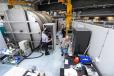
The Platypus instrument can be used to study all-manner of surface-science and interface problems, particularly related to magnetic recording materials and for polymer coatings, biosensors and artificial biological membranes.

Research is being undertaken through an Australian Research Council Discovery Project "Reconstructing Australia’s fire history from cave stalagmites", led by Professor Andy Baker at UNSW Sydney and Dr. Pauline Treble at ANSTO. The project aims to calibrate the fire-speleothem relationship and develop coupled fire and climate records for the last millennium in southwest Australia.

Technical information on the Far Infrared beamline at the Australian Synchrotron.
An accomplished international photographer has capture dazzling new images of one component of the main ring at our Australian Synchrotron and provided an inside view of the electron’s path when it is used.