resurrection

Investigating Radiation Resilience Of Seeds To Grow On The Moon

lunariaone

"We are testing to see where those boundaries are. Life is very resilient, and we have chosen species on purpose that have a lot of resilience – lichens for example have been shown to survive outside the International Space Station" - Dr Lauren Fell, Director - Lunaria One, on ABC News.

The challenge

Understanding the biological limits of life in space is essential for future lunar exploration. Seeds, resurrection plants and lichens are promising candidates for biological payloads because of their natural desiccation tolerance, stress resilience and ability to survive extreme terrestrial environments. Yet their true capacity to endure lunar‑relevant radiation, including secondary heavy‑ion fragments generated inside aluminium‑shielded habitats, remains poorly understood. The Moon’s surface lacks a magnetosphere and atmosphere, exposing any biological system to a radiation field significantly harsher than that on Earth, where galactic cosmic rays and solar energetic particles can exceed terrestrial radiation levels by up to two hundred times. Assessing the radiotolerance of these organisms is therefore vital to determining whether they can be germinated, revived or remain metabolically active during long‑duration lunar missions, and to ensure that their biological functions remain intact after exposure.
The solution

aLEPH2
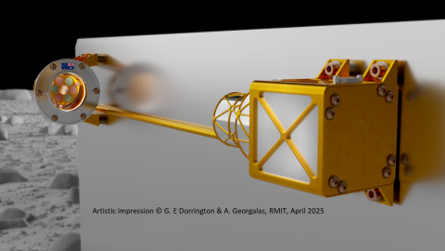
Artistic impression on the ALEPH module housing seeds to be launched to the Moon.

The ALEPH project, funded by the Australian Space Agency under the Moon to Mars initiative, and led by Lunaria One, brings together a consortium of Australian and international partners from government, academia and industry to deliver the first Australian‑designed and built biological module to the lunar surface in 2026, carrying seeds intended to germinate on the Moon. Seeds of fast‑germinating species, the desiccation‑tolerant Tripogon loliiformis, and two radio‑resilient lichens Xanthoparmelia semiviridis and Rhizocarpon geographicum, were selected for irradiation experiments designed to mimic short‑term travel exposures (4 and 8 days) and long‑term lunar surface exposures extending to five years. The challenge was to quantify whether these organisms not only survive but retain structural integrity, germination ability and metabolic activity under doses that reach into the kilogray range when translated into lunar mission timelines. 

lunaria seeds
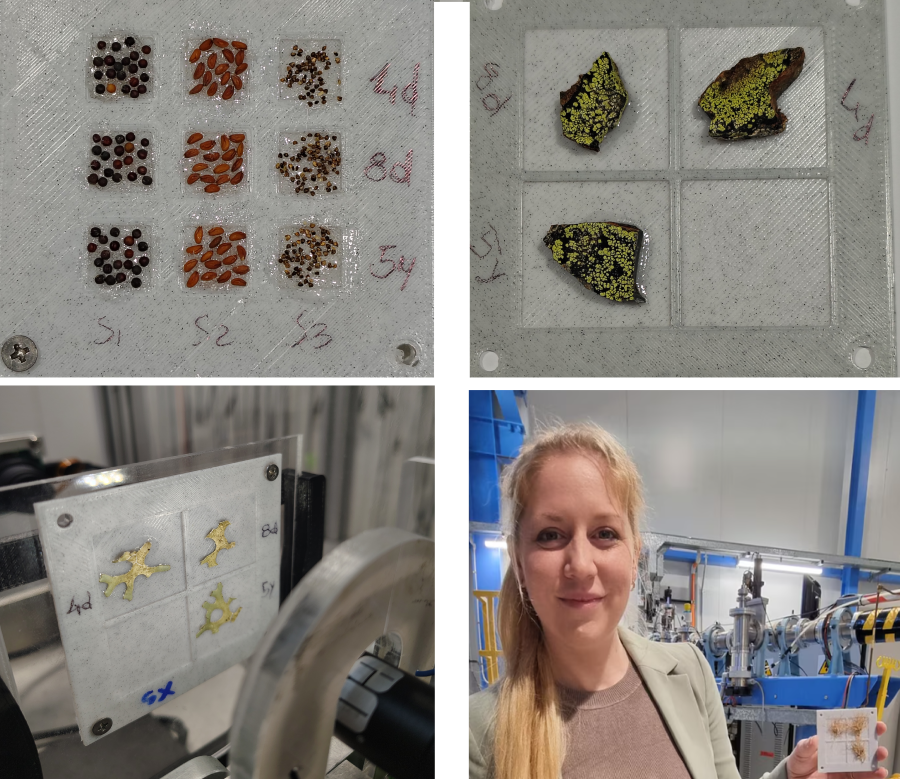
Variety of lichens, seeds and resurrection plants tested inside the in-ambient chamber on the ANTARES microprobe beamline prior irradiation. Dr Lauren Fell holding Tripogon loliiformis samples.

To address these questions, ANSTO’s Centre for Accelerator Science conducted controlled irradiation experiments using aluminium ions accelerated to 56 MeV on the ANTARES microbeamline. Aluminium was chosen because it reflects the dominant material of the ALEPH module, making it an appropriate analogue for secondary radiation fields expected inside lunar habitats. Samples were mounted on custom 3D‑printed holders and irradiated through microbeam scanning, which ensured uniform exposure across seed clusters, lichen thalli and resurrection plant tissues. Immediately after exposure, samples were collected by the QUT and RMIT teams. The biological responses were then assessed using microscopy, germination tests and the FUN‑1 viability assay. Lichens were examined through both SEM‑EDS, which provided insights into elemental composition and microstructural stability, and fluorescent confocal imaging, which allowed researchers to distinguish metabolically active cells based on the presence of red vacuolar fluorescence. Seeds were monitored for germination, root emergence and early leaf formation under controlled environmental conditions. Together, these methods allowed for a comprehensive evaluation of the resilience of each biological system under lunar‑relevant radiation conditions.

The Impact

The irradiation campaign showed that both seeds and lichens possess strong resilience to lunar‑relevant radiation, with lichens maintaining metabolic activity even after exposures equivalent to several years on the Moon, and seeds such as cress and tatsoi continuing to germinate successfully after all irradiation conditions. These findings confirm that selected terrestrial organisms can tolerate the heavy‑ion environment expected inside lunar habitats, reinforcing their suitability for biological experiments on the lunar surface. The results directly strengthen the scientific foundations of the ALEPH mission while simultaneously demonstrating the strategic value of ANSTO’s accelerator‑based testing capabilities. By enabling high‑precision irradiation experiments that cannot be performed elsewhere in Australia, this work highlights the importance of maintaining sovereign national capability in space‑radiation science and facilities. These capabilities not only support Australia’s first biological payload to the Moon but also position the nation as a reliable contributor to international lunar exploration efforts and future Moon‑to‑Mars initiatives.

Lear more about the project and its mission on the ABC News interview.

asa1

This testing campaign was conducted with support from the Australian Space Agency Moon to Mars Demonstrator Mission Grant (Grant number MTMDM000045) awarded to Lunaria One, with project partners including ANSTO and RMIT.

Contact

CAS Irradiations Team Lead