

The AINSE-ANBUG neutron scattering symposium, the biennial gathering of Australian and New Zealand neutron scattering scientists was held over 23-25 November. Over three days the community heard sessions on a range of topics spanning magnetism through to manufacturing. Additionally, the Australian neutron bean users group (ANBUG) awards were presented in tandem with the event, recognising both ANSTO-scientist expertise and early career researchers.
ANBUG Career Award
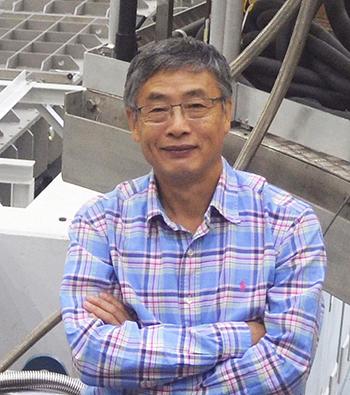
The ANBUG Career Award was presented to Dr Dehong Yu (ANSTO). Dr Yu, who has recently retired from ANSTO, was honoured for his neutron scattering career particularly his sustained leadership in the development of the Pelican time of flight inelastic instrument.
Dr Yu joined ANSTO in 2003 and from 2007 had the remit to building the first time-of-flight neutron spectrometer in the Southern Hemisphere – which became the Pelican instrument.
Over the first 10 years of user operations the Pelican instrument completed over 300 experiments, with results ranging from barochoric materials to fundamental liquid dynamics. In his prize lecture he paid tribute to the large group of researchers and technicians that had come together to make the instrument a success.
The ANBUG Neutron Award
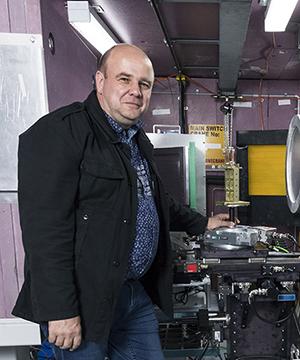
The ANBUG Neutron Award was awarded to Dr Ulf Garbe (ANSTO). Dr Garbe in recognition of his leadership in developing Dingo and its neutron imaging program. Like Dr Yu he arrived at ANSTO to build a brand-new capability within the Australian Centre for Neutron Scattering. In his case this was the Dingo neutron imaging instrument, and as well building this which entered user operations in 2014, he has also worked to foster the neutron imaging community. The instrument is now used for applications from paleobiology to aerospace applications. In his talk he illustrated the capability of the Dingo instrument with the first sample collected on the instrument, and Alarm clock, showing non-destructive power of neutron imaging to peer inside materials
ANBUG Technical Award
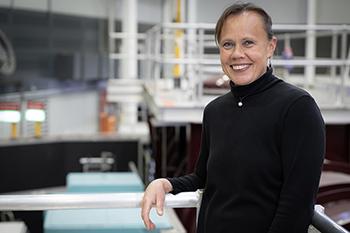
ANBUG’s Technical Award went to Dr Anna Sokolova (ANSTO), in recognition of her sustain technical experience across instrument delivery, challenging experiments, data reduction and user training. Dr Sokolova and her team built the Biby Small angle scattering instrument, one of the largest instruments in the neutron guide hall. She project managed the $11 million instrument build over 5 years to build the instrument, and since commissioning the user program has supported a large range of experimental outcomes.
ANBUG Early Career Scientist Award
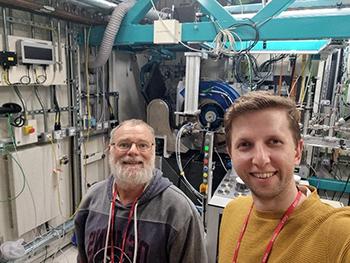
ANBUG’s Early Career Scientist Award was awarded to Dr Fred Malton (University Technology Sydney). Dr Malton was cited for his leadership in the application of local structure analysis from diffraction scattering data. Not only has he pioneered the application of the technique to Australian-led science projects, but he has also worked to help train the wider community in its use. His prize lecture focused on how he has applied this analysis to understanding the local structure of barium bismuth vanadate a promising materials for photo-catalytic applications.
ANBUG Early Career Awards
In further recognition of the early career researchers who use the Australian Centre of Neutron Scattering’s instruments, two outstanding PhD awards were also awarded, to Dr Kyle Portwin and Dr Paul Michalski.
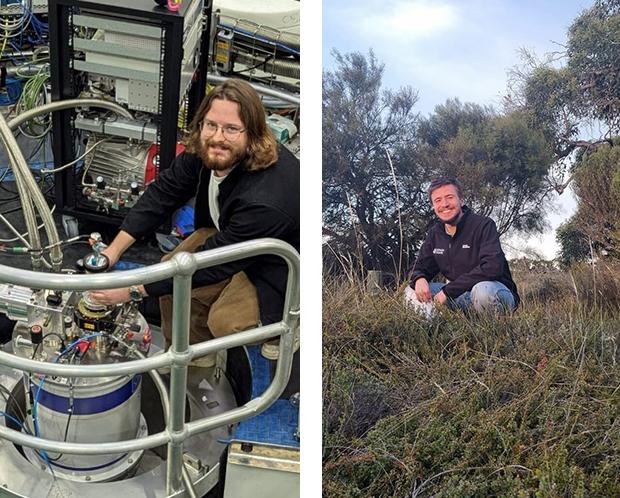
Dr Portwin of the University of Wollongong focused his research on one particular thermoelectric material: tin selenide (SnSe), known for its exceptional thermoelectric performance due to its ultralow thermal conductivity, and moderate electrical conductivity. Using Time-of-Flight INS and DFT calculations, he investigated how SnSe behaves when heated from 100 K – 500 K. The analysis revealed significant broadening of phonon modes, where the vibrations within the material become less well-defined. Normally, phonons have a sharp, clear energy signature, similar to a well-tuned musical note. However, broadening causes this energy range to become fuzzy, like a musical note that’s blurred by nearby vibrations, losing its sharpness and clarity. You can read more on Dr Portwin’s research via this highlight on the AINSE website
Dr Michalski's thesis at Monash University focused on the differences in water and biopolymer dynamics in Australian native fruits. He performed neutron scattering experiments that compared the water structure of apple, with native fruits such as finger limes and muntries. The experiments revealed that, in contrast to apple, each of the Australian native fruits contained water that was bound to the biopolymer of the fruit in a distinctly different way.
The water dynamics specific to the Australian native fruits were consistent with strongly bound water translation that was slower than other fruit: up to 61 % slower than in apple. Knowing this link between water dynamics and drought tolerance will help us assess what fruit can survive in future climates. His work, which used the Pelican and Emu neutron spectrometer instruments, is featured in ANSTO’s Research Impact report 2026 that was launched this week.
Dr Helen Maynard Casely attended the meeting and prepared this report.


