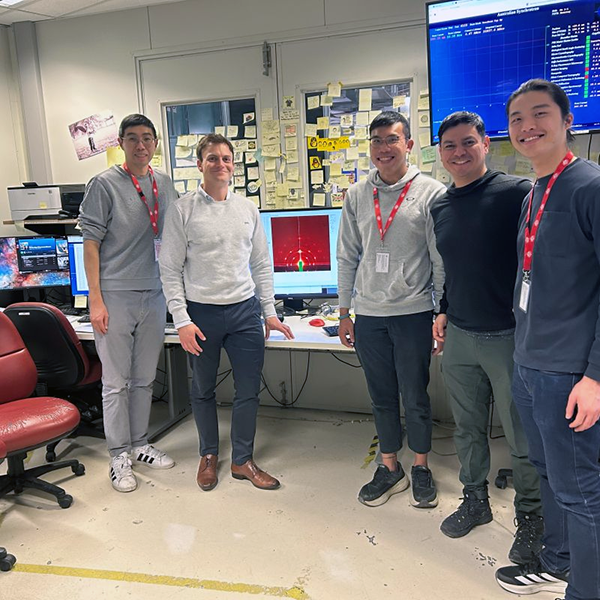
A research team from RMIT University in Melbourne and MIT in the US has taken an important step towards making mRNA vaccines easier to distribute, store and administer as patches.
Lead author Dr Brendan Dyett was part of a team that included Distinguished Professor Calum Drummond of RMIT, and Asst Professor Dr Robert Langer and Dr Ana Jaklenec of MIT, who used the Small-Angle and Wide-Angle X-ray Scattering (SAXS/WAXS) beamlines at the Australian Synchrotron, to reveal critical insights into the behaviour of vaccine nanoparticles during drying and rehydration.
They were exploring whether mRNA vaccines could be incorporated into dissolvable microneedle patches – small, band-aid-like devices that deliver vaccine through the skin and eliminate the need for needles.
The findings demonstrated that dried mRNA vaccines stored in a polymer matrix could reduce reliance on very cold conditions during transport and storage and could lead to the design of more stable lipid nanoparticles and microneedle vaccine patches in the future.
The research, recently published in Advanced Functional Materials, is reported on the RMIT website.
Current mRNA vaccines present significant logistical barriers for remote communities and regions with limited infrastructure for cold transport and storage in developing countries.
_________________________________________________________________________________
The research undertaken at the SAXS/WAXS beamlines was supported by instrument scientists Dr Nigel Kirby and Dr Pablo Mota-Santiago at the Australian Synchrotron.
Lipid nanoparticles are tiny carriers that protect and deliver mRNA into cells. Drying mRNA can alter the delicate internal structure of these nanoparticles—reducing their effectiveness.
“The advanced Synchrotron techniques provided a way to visualise and understand the nanoscale structures governing the stability and performance of the vaccine during drying and rehydration,” said Dr Ashish Sethi, Beamline Group Manager (Scattering).
Experiments revealed that structural changes occurred inside the lipid nanoparticles at the nanoscale, both before and after they were incorporated into the polymer matrix used to fabricate microneedle patches.
They found that lipid nanoparticles reorganised when dried into a solid matrix. Key structural features formed and recovered during rehydration.
Cholesterol crystallisation also affected nanoparticle stability and performance.
And polymer-to-mRNA ratios were needed to maintain nanoparticle integrity and biological activity.
“Conventional techniques alone cannot provide comprehensive information on nanoscale architecture. This work is a great example of how national research infrastructure can help solve practical challenges in improving vaccines. By revealing structural changes that occurred inside lipid nanoparticles during vaccine processing, the SAXS/WAXS beamlines provided critical insights,” said Dr Sethi.
An understanding of the mechanisms could transform fragile liquid mRNA vaccines into stable formulations suitable for next-generation delivery technologies.