A possible world record: Studying thin films under extreme temperatures with reflectometry
A team of researchers from ANSTO and University of Technology Sydney have set a record by conducting thin film experiments at 1100 degrees C.


Showing 681 - 700 of 766 results
A team of researchers from ANSTO and University of Technology Sydney have set a record by conducting thin film experiments at 1100 degrees C.
The process by which plastic degrades in the ocean facilitates its entry into the natural carbon cycle efficiently as carbon dioxide.
ANSTO is proud to support calls for daring and innovative ideas to fight COVID-19 as part of the ACS online Flatten The Curve hackathon.
Radiocarbon analyses on corals from two sites in Australian waters of the southwest (SW) Pacific has indicated significant changes in ocean circulation in the Pacific and large climate variability during the early to mid-Holocene period (8,000-5,400 years ago).
Research confirms that methylcellulose, one of the most widely used hydrogel-forming materials in biomedical research and consumer products, organises itself into a structural architecture
Study shows for the first time that vegetation in the Windmill Islands, East Antarctica is changing rapidly in response to a drying climate.
Commitment to undertake health research.
Australian researchers and clinicians have recently returned from Japan where they investigated the use of advanced radiation therapy for cancer using heavy ions at particle therapy facilities on a study tour .
ANSTO participation in ARC on Intelligent Robotic Systems for Real-time Asset Management has potential benefit in the management of infrastructure and assets
Research makes it possible to assess if and how rocky coasts, which make up the majority of the world’s coasts including Australia and New Zealand, will respond to changes in marine conditions.
Atomic structure of new cathode material for sodium ion batteries helps explain long life

An international team led by scientists at City University of Hong Kong has found flexible metal-organic framework (MOF) with one-dimensional channels that acts as a “molecular trapdoor” to selectively adsorb gases, such as carbon dioxide, in response to temperature and pressure changes.
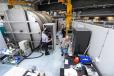
The Platypus instrument can be used to study all-manner of surface-science and interface problems, particularly related to magnetic recording materials and for polymer coatings, biosensors and artificial biological membranes.