
Corporate Publications
Explore ANSTO's range of publications and reports available for the public.


Showing 101 - 120 of 129 results
Explore ANSTO's range of publications and reports available for the public.
ANSTO scientist, Dr Klaus Wilcken of the Centre for Accelerator Science, used cosmogenic nuclide dating to determine the ages of layered sand and gravel samples, in which seven footprints of the flightless bird, the moa, were found on the South Island in New Zealand in 2019.
The proof of concept for the approach used in the early development of the new gamma-ray imaging system has been published,
ANSTO has played a formative role and continues to make important contributions using nuclear and isotopic techniques to understand past climates and patterns of change, maintain water resource sustainability and provide insights into the impact of contaminate in the environment.
The ARC Centre of Excellence (CoE) for Green Electrochemical Transformation of Carbon Dioxide, GETCO2, will support innovative approaches to carbon capture.

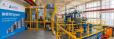
ANSTO Synroc technology provides a safe, secure matrix for the immobilisation and final disposal of radioactive waste.
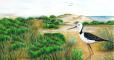
An initiative for National Science Week 2024 the Shorebirds Competition addresses the 2024 theme for National Science Week, ‘Species Survival’ and provides unique cross-curricula learning for Australian primary students in Years 3 to 6.
ANSTO is proud to host the Shorebirds Competition for the fifth year. This unique environmental poster competition is free to enter and offers over $4500 in prizes for students and schools!

ANSTO User Meeting 2021 - Speakers
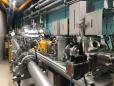
The Medium Energy- X-ray Absorption Spectroscopy beamlines provides access to XANES and EXAFS data from a bending magnet source, optimised for cutting-edge applications in biological, agricultural and environmental science in an energy range that is not currently available at the Australia Synchrotron.
ANSTO has been tracking and publishing data on fine particle pollution from key sites around Australia, and internationally, for more than 20 years.
ANSTO's OPAL reactor is one of the world's most advanced and reliable research reactors today. To ensure we can continue operating OPAL safely and reliably and maximise utilisation, ANSTO must regularly carry out maintenance and upgrades.
From June to August we invited primary schools in Greater Sydney/Illawarra and Melbourne to participate in our 2019 Shorebirds Competition. Students in Years 3 to 6 were asked to create a public awareness poster for a threatened shorebird found in Australia.
A lesson in Science and Sustainability.
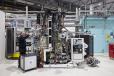
Soft x-rays are generally understood to be x-rays in the energy range 100-3,000 eV. They have insufficient energy to penetrate the beryllium window of a hard x-ray beamline but have energies higher than that of extreme ultraviolet light.