
Director of the new Environment Research and Technology Group
Role at ANSTO
Dr Karina Meredith was appointed Director of the new Research and Technology Group for Environment effective 15 January 2024.


Showing 1061 - 1080 of 1717 results
Dr Karina Meredith was appointed Director of the new Research and Technology Group for Environment effective 15 January 2024.

Role at ANSTO

Recognition of research that developed a life-saving pharmaceutical milkshake using synchrotron techniques.
A collaboration of Australian scientists has used ANSTO’s Australian Synchrotron to measure the amount of carbon that is captured in microscopic seams of deep-sea limestone, which acts as a carbon sink.
A team of scientists from The Australian National University (ANU) has discovered how a powerful “weapon” used by many fungal pathogens enables them to cause disease in major food crops such as rice and corn

A limited amount of travel support is available to students from AINSE member institutes to travel to the New User Sympsosium.

Offered to girls in Years 5, 6 and 7, the STEAM Club encourages creative exploration of Science, Technology, Engineering and Mathematics through the Arts (the A in STEAM).


The schedule for the Australian Synchrotron includes time for shut-down for maintenance and upgrade of the storage ring and beamlines, and operational beamtime.

Originally from Switzerland, Dr Häusermann gained his PhD in x-ray diffraction and synchrotron techniques at King’s College London.

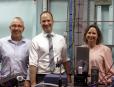
ANSTO and ASTA are partnering with CERN to offer two Australian science teachers the chance to participate in an all-expenses-paid* two-week summer school at the Large Hadron Collider.
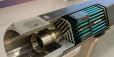
ANSTO researchers are undertaking the fabrication and characterising advanced fuels and investigating the key properties of nuclear waste and its long-term interaction with containment materials to improve safety for short and long-term storage.
Advanced X-ray techniques have revealed new structural details about the specific arrangement of atoms in conjugated polymers, an important class of materials that are used in LEDs, organic solar cells, transistors, sensors and thermoelectric power devices.
New research published in the journal Nature Nanotechnology shows that the next generation of lithium-sulphur (Li||S) batteries may be capable of being charged in less than five minutes, instead of several hours as is currently the case.