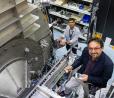
Quokka - Small Angle Neutron Scattering
The QUOKKA instrument provides the powerful technique of small-angle neutron scattering which can look at sizes and structures of objects on the nanoscale including soft matter.


Showing 1241 - 1260 of 1603 results
The QUOKKA instrument provides the powerful technique of small-angle neutron scattering which can look at sizes and structures of objects on the nanoscale including soft matter.

In space, without the protection of the magnetosphere, the type and dose of radiation is considerably different to what is naturally experienced on earth. However, it is the secondary particles of lower energies created when galactic and cosmic radiation interacts with shielding that is of concern for astronauts.


The Planetary Materials theme at ANSTO is co-ordinated by Helen Maynard-Casely and Helen Brand.

Research team for the Aerosol sampling program

ANSTO's procurement policy is closely aligned with the Commonwealth Procurement Guidelines and makes use of the Australian National Audit Office guidelines on ethics, accountability and transparency.
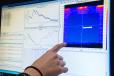
Specifications, Beryllium Filter, User Manual, Instrument reference
ANSTO has released the Independent Safety Review of Building 23 - Nuclear medicine production facility.
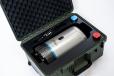
View these case studies for a more detailed look at industry challenges and how CORIS360® radiation imaging technology is improving operational decision making and keeping workers safe.
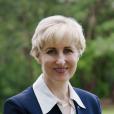
Rear Admiral Richards served in the Royal Australian Navy for over 36 years, bringing extensive experience in engineering, operations, strategic leadership, nuclear safety and regulation. In recognition of her

ANSTO continually collects meteorological data from its 50-metre tower. A summary of ANSTO's climate statistics including temperature, wind speed and direction, relative humidity, atmospheric pressure and rainfall recorded at this location are provided below.

ANSTO's unique capabilities are being used to develop a quick analytical tool to determine the geographic origin of seafood and authenticates quality.
As a new or returning facility user, there are certain requirements that must be completed in advance to allow you to participate in your planned ANSTO experiment(s).

Dr Carol Azzam Mackay is the Design and Innovation Manager at nandin, ANSTO’s Innovation Centre.
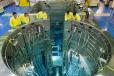
Nuclear science is applied by ANSTO's scientists in many areas that are vital to Australia's future, including agriculture, industry and manufacturing, minerals construction, health and environment. Our work in the development and applications and new knowledge and skills arises from world-class experience in nuclear science and technologies.

Discover the amazing world of nuclear science from your classroom. Join us for Meet an Expert, Nuclear Science Inquiry Skills, Junior Science, and Online Depth Study sessions for Chemistry, Physics and Investigating Science.
Irradiation is the process by which an object is exposed to radiation. Irradiation can be useful for many industry applications.
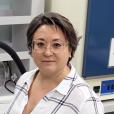
Dr Inna Karatchevtseva undertakes work at ANSTO in two main areas: defence industry research and fundamental materials research.

Do you love science? Here is a competition for you that combines chemistry and creativity! Discover the world of elements and create a poster for your favourite element in this new competition for school aged students.
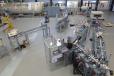
The 6MV tandem accelerator, named SIRIUS, is instrumented with a wide range of AMS, IBA and ion irradiation facilities. The three ion sources include hydrogen and helium sources, and a MC-SNICS sputter source for solid materials.