


Showing 1441 - 1460 of 2448 results

BlueScope Steel Project Summary
BlueScope Steel Project Summary
Introducing a novel molecular orbital interaction that stabilises cathode materials for lithium-ion batteries
A large international team led by scientists from the Institute for Superconducting and Electronic Materials at the University of Wollongong has verified that the introduction of novel molecular orbital interactions can improve the structural stability of cathode materials for lithium-ion batteries.
Reconstructing the history of the Australian landscape
Million year lag time in transport of sediment in Murray Darling River Basin system.
Nuclear medicine supplies guaranteed
Bushfires in proximity to ANSTO during the 2018 bushfires.
Leveraging over half a century of knowledge in the safe management of radioactive waste
ANSTO's Chief Nuclear Officer shares insights on the safe management of Australia's nuclear waste.
Redefining measurements
ANSTO is part of collaboration conducting experiments to redefine the kilogram linking it to a fundamental constant of nature.
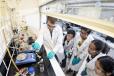
Big Ideas Winners - 2020
Winners of the Big Ideas Competition 2021
Aboriginal inhabitants of Madjedbebe, northern Australia used different ways to adapt to environmental change
ANSTO has contributed to research that indicated that Aboriginal people had a broad diet and intensive plant processing technologies, allowing them to respond to changes in climate, sea level and vegetation over the last ca. 65,000 years.
Showcasing Australian science at the Australian Pavilion Osaka World Expo
ANSTO is part of a contingent showcasing Australian science at the Australian Pavilion at the World Expo Osaka in October.

Public Interest Certificate (PIC) notification schedule
Under the Government Procurement (Judicial Review) Act 2019 (Cth) ANSTO will publish Public Interest Certificates (PICs) for the current financial year where appropriate.
Exceptional group of women at the forefront of science outreach at ANSTO
Five exceptional female science communicators are part of a larger team who use skills in education and engagement to promote an interest in science amongst the public and students.

Airbus Project Summary
Does size matter?
Improving aquaculture for food production in Papua New Guinea
ANSTO joins international counterparts in peaceful nuclear monitoring
The Australian Nuclear Science and Technology Organisation (ANSTO) has joined a team, lead by the US Department of Energy’s Pacific Northwest National Laboratory (PNNL), to install a high resolution monitoring system at ANSTO’s medical isotope production facility in Lucas Heights, Australia.
Progress on BRIGHT Project beamlines
The complex engineering of scientific instruments is explored in this 'behind the scenes' look at the installation of frontends for two new beamlines at the Australian Synchrotron.
Food science: Insight into emulsions
Neutron scattering techniques help characterise the structure of a particle based emulsifier
First neutron topography on Dingo

After your experiment
Following your experiment at the Australian Synchrotron there are certain tasks that users can complete including a user feedback survey and claiming reimbursement for travel expenses.
A bright future for nuclear medicine in Australia
The nuclear medicine community has welcomed the Australian Government’s decision to provide $30 million in funding to ANSTO for the design of a new nuclear medicine manufacturing facility.