Food origin research in global spotlight at Expo 2025 Osaka
ANSTO highlighted its food origin research with live shows and an expert panel discussion to showcase Australian science in the Australia Pavilion at the Expo 2025 Osaka from 8-10 October.


Showing 161 - 180 of 1123 results
ANSTO highlighted its food origin research with live shows and an expert panel discussion to showcase Australian science in the Australia Pavilion at the Expo 2025 Osaka from 8-10 October.

New international limits on the cadmium content of cacao products have spurred research to discover how cadmium accumulates in cacao beans, and the effects of processing.

ANSTO has been tracking and publishing data on fine particle pollution from key sites around Australia, and internationally, for more than 20 years.
Scientists at ANSTO characterise structures with atomic detail using probes such as x-rays, electrons, neutrons and ions.
A team of researchers from ANSTO and University of Technology Sydney have set a record by conducting thin film experiments at 1100 degrees C.


The BRIGHT Nanoprobe beamline provides a unique facility capable of spectroscopic and full-field imaging. NANO will undertake high-resolution elemental mapping and ptychographic coherent diffraction imaging. Elemental mapping and XANES studies (after DCM upgrade) will be possible at sub-100 nm resolution, with structural features able to be studied down to 15 nm using ptychography.

Detailed data on ANSTO electricity use and CO2 emissions for FY2022 - FY2023

ANSTO is committed to monitoring its environmental performance and providing the community with accurate information about it. We also publish live meteorological data from our 49m Lucas Heights weather tower every 15 minutes.
A collaboration of scientists from RMIT, ANSTO and the CSIRO has published pioneering research that brings new insights into intrinsically disordered proteins and protein regions (IDPs)/ (IDRs) and how they behave under various physiological processes.

ANSTO offers capabilities and expertise for the radiation testing and accreditation of space-based systems.
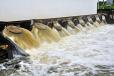
A group from Monash university has sought to make a new innovative nano-porous sieve material which has the potential to be produced on a global scale and is effective for a much longer time.
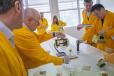
Students investigate the production of nuclear medicines in the OPAL multipurpose reactor, the use of nuclear medicines to diagnose and treat disease, and the science behind working safely with radiation.
This program is designed to address content and skill outcomes in the Year 9 and Year 10 Science Australian Curriculum and NSW syllabuses.
Cost: $90 per class.
Detailed molecular structure of silver nanocrystals determined
Participate in live radiation demonstrations, cover syllabus content and visit ANSTO virtually during our online depth study classes for Year 11 Chemistry.
- Investigate properties of different radioisotopes and learn about their uses in medicine, industry and environmental research.
- Consider the scientific method and gather data during a live radiation experiment.
- See some of Australia's largest scientific infrastructure, including the OPAL multipurpose reactor.
Cost: $90 per class.
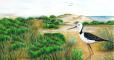
An initiative for National Science Week 2024 the Shorebirds Competition addresses the 2024 theme for National Science Week, ‘Species Survival’ and provides unique cross-curricula learning for Australian primary students in Years 3 to 6.