In this workbook, students will:
- learn about radiocarbon dating and its applications to cultural heritage materials.
- analyse and interpret different texts and videos to better understand Aboriginal and Torres Strait Islander cultures.
- build literacy and numeracy capabilities using cloze passages, writing a glossary, interpreting graphs, answering comprehension questions, and making a timeline and a map to summarise the research stories.

Showing 381 - 400 of 1371 results
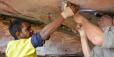
Radiocarbon dating Aboriginal and Torres Strait Islander cultures and histories
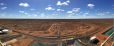
Minerals
ANSTO's Minerals team provides consultancy, process development and research services to the mining and minerals processing industries.

Secondary Education
Challenge your understanding of nuclear science and technology with fun secondary school activities, exciting competitions and unique tours of our facilities.

Year 3 to 6: Science at Work! Tour
Visit world-class science facilities and learn about the important role of scientists in society and the different environments they work in.
Students participate in a fun and engaging "Colour and Light Show" and discuss their science interests with our experienced education team.
All tours are available Monday to Friday for Year 3 to 6 classes. The cost per student is $9 and teachers are free.
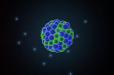
Investigating isotopes
Learn about isotopes using real examples and real data, including comprehensive isotopic data of the first twenty chemical elements in the periodic table (hydrogen to calcium).
Students will:
- learn how the number of neutrons and protons in an isotope affects its nuclear properties
- construct a section of the Table of isotopes, using MS Excel
- investigate the properties and uses of different isotopes
A closer look at the science of detecting flu

Think Science! 2026: Bringing science skills together
The Think Science! competition encourages students in Years 3-10 to learn science inquiry skills in a fun and accessible way! Entry is FREE and there are generous prizes for winning schools. Any topic can be chosen, and special materials are not required.

Visiting Australia

Visiting Australia - ANSTO-HZB Neutron Training Course 2024
Year 11 Chemistry Online Learning
Participate in live radiation demonstrations, cover syllabus content and visit ANSTO virtually during our online depth study classes for Year 11 Chemistry.
- Investigate properties of different radioisotopes and learn about their uses in medicine, industry and environmental research.
- Consider the scientific method and gather data during a live radiation experiment.
- See some of Australia's largest scientific infrastructure, including the OPAL multipurpose reactor.
Cost: $90 per class.

Investigating radiation in the air we breathe
Radon is a significant component of background radiation and can accumulate in poorly ventilated indoor environments.
In this data set, we investigated the effect of electrostatically charging a balloon, which was then hung in an enclosed space, on its level of radioactivity.
Students write a hypothesis, graph data, write a conclusion and use provided information to answer questions about radioactivity and radon, experimental design, accuracy, validity and reliability.
Sharing Sydney’s experience with South Australia
Synchrotron scientist in team that makes historic meteorite find
ANSTO’s own meteorite hunter, who is also a planetary scientist and instrument scientist Dr Helen Brand took part in an expedition led by Professor Andy Tomkins of Monash University that has found the largest meteorite strewn field in Australia since the famous Murchison meteorite event in 1969.
Governor-General visits ANSTO
His Excellency General the Honourable David Hurley AC DSC (Retd), Governor-General of the Commonwealth of Australia and Her Excellency Mrs Linda Hurley visited ANSTO’s Innovation Centre nandin and several facilities including the OPAL multipurpose reactor this week for a tour after learning of the ANSTO-nandin win in the NASA SpaceApps COVID 19 Challenge.
Aboriginal inhabitants of Madjedbebe, northern Australia used different ways to adapt to environmental change
ANSTO has contributed to research that indicated that Aboriginal people had a broad diet and intensive plant processing technologies, allowing them to respond to changes in climate, sea level and vegetation over the last ca. 65,000 years.
Supercomputing to track the sun's history
Supercomputing power helps unlock secrets in the ice.
Teachers Down Under Head to CERN: Australian Educators Selected for International High School Teacher Program
Part of the Large Hardon Collider
Looking deeply in nitrogen cycling
New three year study with UNSW for Cotton Research Development Corporation.