

Showing 61 - 80 of 142 results
Advanced reactor research: Student opportunity
ANSTO is interested finding students to collaborate on Generation IV reactor systems.
Isoscapes of groundwater in NSW will benefit water managers
A large group of ANSTO environmental scientists and collaborators have produced the first groundwater stable isotopes, ‘isoscapes’, intuitive maps with grid data, across NSW combining new and pre-existing isotope measurements.
Australian Industry Becquerel Traceability Program (AIBTP)
The Australian Industry Becquerel Traceability Program (AIBTP) provides facilities with direct measurement traceability to the Australian standard for the activity of radionuclides used in Positron Emission Tomography (PET).
Trash to treasure with 3D printing breakthrough
New technology is being developed in Sydney to recycle used Personal Protective Equipment (PPE) and turn it into raw materials for 3D printing.
Specialist expertise and capabilities at ANSTO enable an understanding and improvement of current and advanced nuclear fuel materials
With a well-established portfolio of nuclear research and the operation of Australia's only nuclear reactor OPAL, ANSTO scientists conduct both fundamental and applied research on fuel for current, advanced, and future nuclear technology systems.

Director of the new Environment Research and Technology Group
Role at ANSTO
Dr Karina Meredith was appointed Director of the new Research and Technology Group for Environment effective 15 January 2024.
A look back at the monumental achievement of constructing the OPAL reactor
INVAP, the Argentinian advanced nuclear technology company, who designed and constructed the Open Pool Lightwater Reactor (OPAL) for ANSTO to replace the HIFAR reactor is celebrating 50 years of operations with the visit of a group of INVAP executives to ANSTO to celebrate their achievements and discuss future collaborations.
Greater Sydney Commission and ANSTO reveal innovation plans for Sydney’s South
Australian led cancer project making an impact at its first regional training course in Malaysia
The Australian led regional cancer care project in medical physics held its first regional training course in Malaysia to progress Rays of Hope.
The world’s best radon detector just got smaller
The need for a smaller, more transportable version of ANSTO’s 1500-litre atmospheric radon-222 monitor, and with a calibration traceable to the International System of Units, prompted the team to develop a 200-litre radon monitor that would meet those needs.
Rare boomerangs used by ancestors of Yandruwandha Yawarrawarrka people dated at ANSTO
A rare collection of traditional Aboriginal wooden objects in varying degrees of preservation found along a dry creek bed in South Australia have been dated to a period spanning 1650 to 1830 at the Centre for Accelerator Science at ANSTO.
Features and benefits
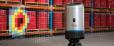
Overlaying a 360° x 90° radiation image onto a panoramic optical image of the scene, makes interpretation much easier. The spectroscopic detector at the heart of the imager enables the accurate visualisation and identification of sources across a broad energy range.
Technology pioneered at ANSTO
Technology at heart of award-winning wastewater innovation from BioGill.

CORIS360® GNI - Gamma Neutron Imager
CORIS360® GNI images gamma-ray and thermal neutron radiation sources, delivering an unprecedented ability to detect, localise, and identify nuclear materials.
ANSTO recognises the contribution of staff for outstanding work, innovation, and excellence
ANSTO announces the recipients of the 2022 organisational awards
Sharing expertise with regional neighbours
Participants undertook IAEA training hosted by Macquarie University and ANSTO on use of radionuclides for soil and water investigations.
Australia’s OPAL multi-purpose reactor prepares for new milestone
Routine transport of spent nuclear fuel
ANSTO researchers among materials, environment and health projects funded by new ARC grants

OPAL multi-purpose reactor
Australia’s Open Pool Australian Lightwater (OPAL) reactor is a state-of-the-art 20 megawatt multi-purpose reactor that uses low enriched uranium (LEU) fuel to achieve a range of activities to benefit human health, enable research to support a more sustainable environment and provide innovative solutions for industry.