Creative Kids Voucher can be used for school holiday workshops
Parents can use their NSW Government Creative Kids Voucher to pay for ANSTO's School Holiday workshops.


Showing 61 - 80 of 1815 results
Parents can use their NSW Government Creative Kids Voucher to pay for ANSTO's School Holiday workshops.
A research team from ETH Zurich developing and characterizing silicon carbide devices for power electronics, recently spent time at ANSTO’s Centre for Accelerator Science to use a specialised beamline in their investigations.

ANSTO has a role in the global monitoring system on behalf of Australia to ensure non-proliferation of weapons and that nuclear technology is only used for peaceful purposes.
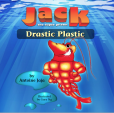
Jack the Super Prawn lives in the Great Barrier Reef and uses his superpowers to protect the environment. Jack’s main job is to educate young readers on the impact of plastic and other types of pollution and to empower them to find a solution.
Created by Antoine Jaja, Jack’s first two adventure books entitled, “Drastic Plastic” and “Pollution Solution,” are now available in paperback in bookstores throughout Australia, as well as the ANSTO Shop. ANSTO provided scientific input into these stories that are helping to raise awareness of the impact of pollution on our waterways and the marine environment.

ANSTO provides access to specialised facilities and capabilities by application. Please ensure that you contact the relevant ANSTO scientist for advice before submitting a proposal.
A rare collection of traditional Aboriginal wooden objects in varying degrees of preservation found along a dry creek bed in South Australia have been dated to a period spanning 1650 to 1830 at the Centre for Accelerator Science at ANSTO.
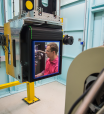
The High Performance Macromolecular Crystallography beamline will enable the study of very small (sub-5 micrometre) or weakly diffracting crystals, providing a state-of-the-art high-throughput facility for researchers. MX3 will be able to study the structures of large proteins and protein complexes for virology, drug design and industrial applications via goniometer mounted crystals, in-tray screening, or via serial crystallography methods.
Scientists from the Walter and Eliza Hall Institute (WEHI) are using the unique immune system of the alpaca and techniques at the Australian Synchrotron as part of research using antibodies to disrupt COVID-19 viral entry into cells.
Research confirms that methylcellulose, one of the most widely used hydrogel-forming materials in biomedical research and consumer products, organises itself into a structural architecture
The University of Newcastle and UNSW [GW1] are using advanced neutron scattering techniques at ANSTO to carry out research on the structure of polymers in complex salt environments that will ultimately provide a way to predict their behaviour for real-world applications.
The Powder Diffraction beamline at the Australian Synchrotron is optimised for carrying out structural investigation under non ambient conditions and as a function of time.
Experiments undertaken at the Australian Synchrotron have allowed research teams from Monash University and La Trobe University to clarify fundamental aspects of T-cell activation crucial to the body’s immune response to disease.
Scientists from Monash, ANSTo and China have developed an ultra-thin membrane that could separate harmful ions from water or capture gases.
ANSTO has contributed to research that indicated that Aboriginal people had a broad diet and intensive plant processing technologies, allowing them to respond to changes in climate, sea level and vegetation over the last ca. 65,000 years.
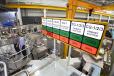
Fifteen neutron beam instruments are either operational or being commissioned at the new OPAL reactor. ANSTO expects to add more instruments in future. Other instruments and a suite of sample-environment equipment allows studies at different temperatures, pressures and magnetic fields. Scientific references are available for most instruments.
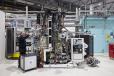
Soft x-rays are generally understood to be x-rays in the energy range 100-3,000 eV. They have insufficient energy to penetrate the beryllium window of a hard x-ray beamline but have energies higher than that of extreme ultraviolet light.