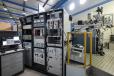
Accelerators and instruments
The Centre for Accelerator Science operates four ion accelerators with 11 on sources and 13 beamlines


Showing 81 - 100 of 3560 results
The Centre for Accelerator Science operates four ion accelerators with 11 on sources and 13 beamlines





The Australian Government recently signed a landmark emissions reduction technology deal with Great Britain, which includes nuclear energy and clean hydrogen among the six key low emission technologies the two countries hope to advance.

A tiny 8mm by 6mm radioactive capsule went missing in January 2023, somewhere along a 1400 kilometre journey from Rio Tinto’s Gudai-Darri iron ore mine to its final destination in Perth, Western Australia. Find out how ANSTO's CORIS360® technology identified the exact location of the missing source.

ANSTO provides a summary of waste production and consumables for FY2022 - FY2023

ANSTO has been measuring and characterising fine particle pollution from key sites around Australia for more than 30 years.
This data set provides records from 1998 to 2019 of the concentration of 12 elements present in fine airborne particulate matter from an air sampling station located in Mayfield in Newcastle, NSW.

ANSTO provides a summary of water usage and discharge for FY2022 - FY2023
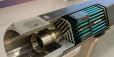
ANSTO researchers are undertaking the fabrication and characterising advanced fuels and investigating the key properties of nuclear waste and its long-term interaction with containment materials to improve safety for short and long-term storage.
A large collaboration of European investigators gained insights into how the SARS-CoV-2 spike protein (S protein) impacts with lipid metabolism in the body with implications for COVID-19 infection and mRNA vaccination.
ANSTO has recently concluded up a successful cross-cultural nuclear science education project between Australia and Japan.
The unique magnetic properties and nontrivial quantum effects were observed and measured in an advanced material with potential application for quantum computing.
ANSTO renewed its Memorandum of Understanding (MOU) with the Japan Proton Accelerator Research Complex (J-PARC) operated by the High Energy Accelerator Research Organisation (KEK) and Japan Atomic Energy Agency (JAEA). Now broadened to include their partner Comprehensive Research Organization for Science and Society (CROSS), the signing took place early in the year and a celebratory workshop was held late July.