
How safe is OPAL?
The OPAL research reactor's design and integrated safety features mean it is extremely safe; a fact confirmed by independent analysis.


Showing 161 - 180 of 548 results
The OPAL research reactor's design and integrated safety features mean it is extremely safe; a fact confirmed by independent analysis.

The Think Science! event encourages students to engage with the Science Inquiry Skills process as outlined in the Australian National Curriculum.

Australasia is home to some of the oldest rock art motifs in the world. In tropical latitudes, due to climate change, the rock art deterioration is accelerating.

View the upcoming proposal deadlines for access to ANSTO’s Research Portal. The User Office provides support for research proposals and enables you to leverage our world-class research infrastructure and facilities.
Radiocarbon measurements at ANSTO’s Centre for Accelerator Science have supported research published that provided insights into what the environment was like for the Aboriginal artists who created rock art over intervals spanning 43,000 years.

Frequently asked questions about the ANSTO Security Process, travel funding, ANSTO Research Portal and ACNS Customer Portal.

Detailed data on ANSTO electricity use and CO2 emissions for FY2024 - FY2025
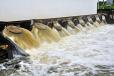
A group from Monash university has sought to make a new innovative nano-porous sieve material which has the potential to be produced on a global scale and is effective for a much longer time.

Offered to girls in Years 5, 6 and 7, the STEAM Club encourages creative exploration of Science, Technology, Engineering and Mathematics through the Arts (the A in STEAM).



ANSTO provides trusted advice, training and consultancy services to Australia’s resource sector.
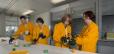
ANSTO is a recognised leader in radiation safety training, offering courses recognised by industry and relevant regulators.
Researchers developing new materials and devices that can withstand the harsh radiation environment in space are using the unique ANSTO’s capability to simulate the effects of high-energy ion irradiation on the properties and performance of these materials and devices.

ANSTO’s user office in Melbourne offers access to the Australian Synchrotron, a world-class research facility with over 4,000 user visits per year. ANSTO seeks collaboration and partnerships with research organisations, scientific users and commercial users.
ANSTO recently re-started the OPAL Reactor after a six-month shutdown for essential maintenance and the installation of an upgraded facility.

The Infrared microspectroscopy microscopes can record spectra from a range of different samples; from thin microtomed sections to polished blocks and embedded particles. This section highlights the types of samples that can be analysed using the IRM beamline

Think Science! 2025 Summary and results
High intensity X-ray beam provides insights into the activity of natural killer cells.