Search hero banner

Search results

Showing 21 - 40 of 766 results

Dr Quan Hua
Senior Principal Research Scientist

Role at ANSTO

Diversity and inclusion at ANSTO

Diversity, Equity, Inclusion and Belonging

At ANSTO we understand that diverse teams produce better outcomes – and we value the merit that a diverse perspective can bring to the quality and outcomes of our work, and the way we get the job done.

Cryogenic Permanent Magnet Undulator (CPMU) source for the BRIGHT Nanoprobe beamline

Nanoprobe beamline (NANO) - under construction

The BRIGHT Nanoprobe beamline provides a unique facility capable of spectroscopic and full-field imaging. NANO will undertake high-resolution elemental mapping and ptychographic coherent diffraction imaging. Elemental mapping and XANES studies (after DCM upgrade) will be possible at sub-100 nm resolution, with structural features able to be studied down to 15 nm using ptychography.

Chen (Terry) Guo
Masters of Design Student - Swinburne University

Terry has studied in Singapore and Australia, focusing on teaching design. He is passionate about cross-cultural interactive learning and design research to inspire new and innovative concepts.

CORIS360 product in carry case

CORIS360® case studies

View these case studies for a more detailed look at industry challenges and how CORIS360® radiation imaging technology is improving operational decision making and keeping workers safe.

Dr Eugenia Kuo
Research Scientist/Structural Modeller, Nuclear Fuel Cycle

Role at ANSTO


Magnetism at ANSTO

Magnetism

As an experimental tool for the study of magnetism, neutron scattering is without equal in its range of applications.

Energy Materials

Energy Materials

Creating a global energy system that is both environmentally and economically sustainable is unquestionably one of the largest challenges facing the scientific and engineering communities.

High Performance Macromolecular Crystallography Beamline (MX3)

High Performance Macromolecular Crystallography Beamline (MX3)

The High Performance Macromolecular Crystallography beamline will enable the study of very small (sub-5 micrometre) or weakly diffracting crystals, providing a state-of-the-art high-throughput facility for researchers. MX3 will be able to study the structures of large proteins and protein complexes for virology, drug design and industrial applications via goniometer mounted crystals, in-tray screening, or via serial crystallography methods.

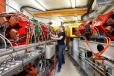
Woman standing next to accelerator transport line

Particle Accelerators

The Accelerator Science group purse a broad research program with the aims of improving the performance and reliability of our accelerators, increasing their research capabilities and developing the next generation of accelerator technology.

Astronaut floating cells

Radiation biology

In space, without the protection of the magnetosphere, the type and dose of radiation is considerably different to what is naturally experienced on earth.

Pagination