
Technical information - Kookaburra
Specifications, Instrument layout, and Instrument reference


Showing 241 - 260 of 399 results
Specifications, Instrument layout, and Instrument reference
Study helps make carbon dating a more accurate chronological tool.
Monica Hibberd and Hamish McDougall are working together on research into greener and more efficient energy and battery technology.


The BRIGHT Nanoprobe beamline provides a unique facility capable of spectroscopic and full-field imaging. NANO will undertake high-resolution elemental mapping and ptychographic coherent diffraction imaging. Elemental mapping and XANES studies (after DCM upgrade) will be possible at sub-100 nm resolution, with structural features able to be studied down to 15 nm using ptychography.

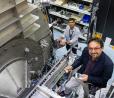
The QUOKKA instrument provides the powerful technique of small-angle neutron scattering which can look at sizes and structures of objects on the nanoscale including soft matter.
Testing at ANSTO’s Centre for Accelerator Science supports an action plan just published by the Australian Packaging Covenant Organisation (APCO) to phase out per- and polyfluoroalkyl substances (PFAS) in fibre-based food contact packaging in Australia by December 2023.
Phase contrast tomography shows great promise in early stages of study and is expected to be tested on first patients by 2020.
The University of Newcastle and UNSW [GW1] are using advanced neutron scattering techniques at ANSTO to carry out research on the structure of polymers in complex salt environments that will ultimately provide a way to predict their behaviour for real-world applications.

Radioisotopes are widely used in medicine, industry, and scientific research. New applications for radioisotopes are constantly being developed.
Researchers based at Monash University and the Swedish Museum of Natural History have pioneered the use of nuclear imaging techniques at ANSTO’s Centre for Neutron Scattering to resolve long-standing problems in plant evolutionary history linked to wildfires.
Outstanding individuals and teams have been recognised for their outstanding work, innovation, excellence in the 2025 ANSTO Awards.
Research on the mechanism of cell death has insights to bring progress on neurodegenerative diseases and plant biosecurity.
A collaboration of scientists from RMIT, ANSTO and the CSIRO has published pioneering research that brings new insights into intrinsically disordered proteins and protein regions (IDPs)/ (IDRs) and how they behave under various physiological processes.

ANSTO User Meeting 2021 - Speakers
With a well-established portfolio of nuclear research and the operation of Australia's only nuclear reactor OPAL, ANSTO scientists conduct both fundamental and applied research on fuel for current, advanced, and future nuclear technology systems.