
ANSTO Synroc® - Radioactive Waste Treatment Technology
ANSTO Synroc technology provides a safe, secure matrix for the immobilisation and final disposal of radioactive waste.


Showing 41 - 55 of 55 results
ANSTO Synroc technology provides a safe, secure matrix for the immobilisation and final disposal of radioactive waste.

In Australia and the Southeast Asia basin, the ANSTO facility offers a wide range of unique nuclear-beam techniques for cultural heritage research.
The newly built Medicines Manufacturing Innovation Centre (MMIC), co-located at the Australian Synchrotron at Clayton, was officially opened on Wednesday by the Victorian Deputy Premier and Minister for Medical Research the Hon Ben Carroll.

This science week ANSTO (August 10th - 18th) is running a classroom competition using the ANSTO Periodic Table and our new ANSTO XR app.
ANSTO commenced an aerosol sampling program thirty years ago this week to characterise these pollutants and ultimately, identify their sources, which has taken it to the forefront of environmental monitoring of this type in Australia and the region.
Recently, a small delegation, including Yandruwandha Yawarrawarrka representatives from the remote outback settlement of Innamincka SA, travelled to ANSTO to deliver rare wooden Aboriginal archaeological artefacts for measurements to determine their age and origin.
The proof of concept for the approach used in the early development of the new gamma-ray imaging system has been published,

ANSTO has been tracking and publishing data on fine particle pollution from key sites around Australia, and internationally, for more than 20 years.

The Advanced Diffraction and Scattering beamlines (ADS-1 and ADS-2) are two independently operating, experimentally flexible beamlines that will use high-energy X-ray diffraction and imaging to characterise the structures of new materials and minerals.

Archive of ANSTO research publications, seminars and short talks.

ANSTO’s user office in Melbourne offers access to the Australian Synchrotron, a world-class research facility with over 4,000 user visits per year. ANSTO seeks collaboration and partnerships with research organisations, scientific users and commercial users.
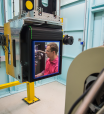
The High Performance Macromolecular Crystallography beamline will enable the study of very small (sub-5 micrometre) or weakly diffracting crystals, providing a state-of-the-art high-throughput facility for researchers. MX3 will be able to study the structures of large proteins and protein complexes for virology, drug design and industrial applications via goniometer mounted crystals, in-tray screening, or via serial crystallography methods.