Fusion research in Australia
Australia part of global renaissance in fusion power research symbolised by ITER experiment


Showing 81 - 100 of 157 results
Australia part of global renaissance in fusion power research symbolised by ITER experiment
Blake Orr from ARPANSA review the Netflix series Radioactive Emergency.
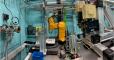
With enhanced submicron spatial resolution, speed and contrast, the Micro-Computed Tomography beamline opens a window on the micron-scale 3D structure of a wide range of samples relevant to many areas of science including life sciences, materials engineering, anthropology, palaeontology and geology. MCT will be able to undertake high-speed and high-throughput studies, as well as provide a range of phase-contrast imaging modalities.
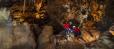
Research is being undertaken through an Australian Research Council Discovery Project "Reconstructing Australia’s fire history from cave stalagmites", led by Professor Andy Baker at UNSW Sydney and Dr. Pauline Treble at ANSTO. The project aims to calibrate the fire-speleothem relationship and develop coupled fire and climate records for the last millennium in southwest Australia.
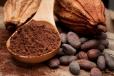
New international limits on the cadmium content of cacao products have spurred research to discover how cadmium accumulates in cacao beans, and the effects of processing.

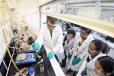
Winners of the Big Ideas Competition 2021
Collaboration finds that old carbon reservoirs are unlikely to cause a massive greenhouse gas release in a warming world.
A specialist in particle therapy treatment planning from the Mayo Clinic in the US, Professor Chris Beltran, recently visited ANSTO for an exchange for information.
Australia and Sri Lanks signs new partnership to fight chronic kidney disease.

Stable isotopes are high useful in investigations of environmental samples.


The National Deuteration Facility offers access to deuterated molecules prepared by both in vivo biodeuteration and chemical deuteration techniques.
ANSTO has supported a new study published in Quaternary Science Reviews that dates the dramatic collapse of one of the largest glaciers ever documented in the Himalayas. The findings overturn a long-held assumption about what sustains wet-climate glaciers.
ANSTO has hosted its second IAEA Practical Introduction to Nuclear Forensics Regional Training Course for representatives of member countries from South-East Asia, sharing expertise on the theoretical and practical aspects of nuclear forensics to respond to incidents of nuclear or other radioactive material out of regulatory control.