
Publications - Infrared microspectroscopy
Resources and a list of user publications associated with Infrared microspectroscopy.


Showing 801 - 820 of 1123 results
Resources and a list of user publications associated with Infrared microspectroscopy.
Nine PhD students are taking part in a rare opportunity to deliver an innovative solution to a real-world challenge for an industry partner in ANSTO’s National Graduate Innovation Forum in association with the Australian Council of Deans of Science and the Australian Institute of Nuclear Science and Engineering.
Publications and resources from the Powder Diffraction beamline.
Stage 1 of the Stawell Underground Physics Laboratory was officially opened today. It will be home to multi-disciplinary scientists from five research partners who help us understand dark matter.
ANSTO researchers have demonstrated longstanding expertise in the study of nuclear fuel and radioactive waste with two recent journal articles in a special issue of Frontiers of Chemistry.
ANSTO environmental scientists contribute to investigation of carbon capture in wetlands.
Defence Materials Technology Centre honours achievements of two ANSTO collaborators.
Dr Anna Paradowska has been appointed as a Conjoint Professor of Practice in Advanced Structural Materials at the University of Sydney.
A specialist in particle therapy treatment planning from the Mayo Clinic in the US, Professor Chris Beltran, recently visited ANSTO for an exchange for information.
ANSTO-nandin innovation hub win global hackathon challenge from NASA with COVID19 solution.
Atmospheric scientists have developed a new technique to measures the naturally-occurring radioactive gas radon for use in accurately categorising the degree of atmospheric mixing.
ANSTO has installed a radon detector for Curtin University in Burrup WA as part of the Murujuga Rock Art Monitoring Program
ANSTO’s own meteorite hunter, who is also a planetary scientist and instrument scientist Dr Helen Brand took part in an expedition led by Professor Andy Tomkins of Monash University that has found the largest meteorite strewn field in Australia since the famous Murchison meteorite event in 1969.
In cooperation with ANSTO and for the third year running, the IAEA has recently hosted a two-week online training course for women professionals working in numerous nuclear industries around the world, titled 'Women 4 Nuclear Science in Education and Communications'.

The National Deuteration Facility has supported industry through the synthesis of deuterated mineral oil, which was supplied to Japanese chemical manufacturer Mitsui Chemicals. Mitsui Chemicals specialises in polymeric materials for packaging, appliances, construction and other applications.
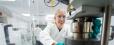
Polarised neutron scattering on Sika instrument