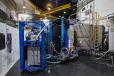
Freely Accessible Remote Laboratories (FarLabs) have developed a nuclear remote online laboratory that schools can use to perform experiments with nuclear radiation. Two experiments allow students to investigate the penetrating power of different forms of radiation and how the amount of radiation decreases with distance.
The FarLabs project is led by the Department of Physics at La Trobe University in collaboration with James Cook University, Curtin University, Quantum Victoria, V3 Alliance, and ANSTO.
Showing 901 - 920 of 1371 results
All spins point up for SIKA
Polarised neutron scattering on Sika instrument
Two international agreements signed
Historic memorandums of understanding on the peaceful use of nuclear with Thailand and Canada.
Researcher awarded Young Innovator scholarship
Peter Kabokov will continue work that will contribute to defence industry
Nuclear remote online Laboratory (FarLabs)
Periodic table photo competition results
This science week ANSTO (August 10th - 18th) is running a classroom competition using the ANSTO Periodic Table and our new ANSTO XR app.
Role at ANSTO
Role at ANSTO
Funding backs ANSTO‑led program to develop new treatment for deadly brain cancers
ANSTO has secured a $1.62 million Medical Research Future Fund (MRFF) grant under the Australian Brain Cancer Mission’s 2024 Brain Cancer Discovery and Translation program
A simplified way to produce new class of molecules with potential application for preparation of nanomaterials
Neutron scattering helping conserve the world’s great historic monuments
Jarosite on Earth and Mars
Useful in some mineral processes but a major problem in others, jarosite may be the key to unlocking the geological history and environmental context of water on Mars.
Nuclear science informing risk assessments during offshore decommissioning
Environmental scientists at ANSTO have been undertaking research to gain a better understanding of the potential impact of contaminants on decommissioned offshore oil and gas infrastructure since 2017.
Nuclear science informing risk assessments during offshore decommissioning
Environmental scientists at ANSTO have been undertaking research to gain a better understanding of the potential impact of contaminants on decommissioned offshore oil and gas infrastructure since 2017
Blueprint for future drugs
Structure of protein involved in immune response pair revealed.
New antibody-like molecule which could be used in therapy to prevent infection from multiple forms of malaria
The protein mapping workhorses of the Australian Synchrotron, Macromolecular and Microfocus crystallography beamlines, MX1 and 2, continue to support important biomedical research in the development of vaccines and new therapeutics.
Combining irradiation and lithography to engineer advanced conducting materials
Services - Taipan
Sample environments, Data analysis, SpICE and SICS