Discovery of molecular structure wins prestigious chemistry award
Research demonstrates the existence of hexagonal planar geometry in a transition metal complex with great potential application across multiple disciplines.


Showing 1101 - 1120 of 2173 results
Research demonstrates the existence of hexagonal planar geometry in a transition metal complex with great potential application across multiple disciplines.
The ANSTO Awards in Nuclear Science and Technology 2018 were presented on Friday 2 November at The Australian Museum, and showcased ANSTO’s unique nuclear science and technology capabilities, which enable progress in the key areas of health research and innovation for industry.
The outcome could have significant implications for better monitoring, management and remedial action of groundwater globally.
Environmental scientists at ANSTO have been undertaking research to gain a better understanding of the potential impact of contaminants on decommissioned offshore oil and gas infrastructure since 2017
Researchers developing new materials and devices that can withstand the harsh radiation environment in space are using the unique ANSTO’s capability to simulate the effects of high-energy ion irradiation on the properties and performance of these materials and devices.
ITRAX has now analysed more than a kilometre of cores since it became operational in 2012.
Dr Linda Croton, a Research Fellow at Monash University, has been awarded the 2020 ANSTO Australian Synchrotron Stephen Wilkins Thesis medal for her outstanding work using synchrotron-based X-ray for brain imaging.

Links to all previous news and case studies published by the National Deuteration Facility


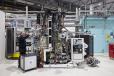
An analysis program for viewing and analysing near-edge X-ray absorption fine-structure (NEXAFS) spectra.
Snapshots of an unprecedented double element-hydrogen bond activation at a transition metal centre.
There have been significant developments in small modular reactor technologies in 2022. The International Atomic Energy Agency expects small modular reactors (SMRs) to make an important contribution to achieving global climate goals and energy supply security. But with more than 70 SMR designs under development in 18 countries – including innovative reactors that are yet to be licensed and novel methods of modular manufacturing that are new to the nuclear industry – widely deploying SMRs in time remains a tall task.
Two approaches use existing low cost and low energy technologies to reuse stockpiled waste from mining operations - capturing carbon dioxide in the form of valuable carbonate minerals.
ANSTO has contributed to a large international study which decodes a fundamental process in Earth’s history and provides guidelines regarding the types of research questions that palaeontologists can investigate using marine fossils.
ANSTO will make an application to the independent nuclear regulator, ARPANSA, to vary its license for its Interim Waste Store. The original operating license was approved in 2015, enabling the facility to hold what is called a TN-81 cask of intermediate-level radioactive waste that was safely repatriated from France in 2015.