

Showing 121 - 140 of 216 results

The Australian Synchrotron
A world-class national research facility that uses accelerator technology to produce a powerful source of light-X rays and infrared radiation a million times brighter than the sun.

COVIDSafe Plan
This COVIDSafe Plan describes the actions that ANSTO will take to keep our staff, contractors and visitors safe and minimise the risk of the spread of COVID-19 infection.
ANSTO provides groundwork for promising new nuclear medicine
Clarity Pharmaceuticals is building on comprehensive work on chelators carried out at ANSTO.
Studying Western Australian caves to help us understand climate change
On average, there is now 17 per cent less rainfall across Western Australia’s south-western region than was recorded prior to 1970. This rainfall reduction has economic, social and environmental implications for the region, in particular for the growing capital of Perth, as well as water-dependent industries in the state.
Nuclear techniques confirm rare finding that crocodile devoured a baby dinosaur

Safeguarding the future of Australia's nuclear medicine
The new facility will be built around a product line of ANSTO’s design – a new Technetium-99m generator – that will enable greater process automation than is possible with existing technology, leading to improvements in efficiency, quality and importantly the highest levels of production safety.
Sydney and Perth schools tackle playground waste and clean up with first prize in ANSTO's hackathon
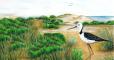
2022 Shorebirds Competition Summary and Results
Shorebirds Competition 2022 results.
Combining irradiation and lithography to engineer advanced conducting materials
Tracing the impact of toxic metals
Two ANSTO environmental scientists are part of a large team led by the Australian National University (ANU), who have received an Australian Research Council Discovery Project grant to investigate how environmental change and human activities since industrialisation have impacted the transport and deposition of toxic metals on the south coast of Australia, Tasmania, and remote Southern Ocean islands.
TSPO: Ancient gene ignites potential for drug development
Structural studies of silk
New infrared imaging technique reveals molecular orientation of proteins in silk fibres
Multiple techniques elucidate hardness with radiation damage
3D models of multilayered structures on engineering scale from nanoscale damage profiles.
Using the power of artificial intelligence to help detect disease
An international collaboration led by The University of Sydney and supported by ANSTO has developed an advanced, innovative artificial intelligence application that could be used to help examine tissue samples and identify signs of disease/
New technique to improve global climate models
An investigation that set out to resolve some of the uncertainty in the sources and quantities of pollutants reaching Antarctica has produced a new experimental technique to identify and characterise recently terrestrially-influenced air reaching Antarctica.
Netflix series 'Radioactive Emergency' reviewed by ARPANSA and ANSTO radiation experts
Blake Orr from ARPANSA review the Netflix series Radioactive Emergency.

Principal Research Scientist
Role at ANSTO

Samples - Infrared microspectroscopy
The Infrared microspectroscopy microscopes can record spectra from a range of different samples; from thin microtomed sections to polished blocks and embedded particles. This section highlights the types of samples that can be analysed using the IRM beamline